
THE SHORT ANSWER
Crawl budget matters when a large or frequently changing URL inventory prevents important pages from being fetched promptly. Smaller consulting websites usually have more immediate priorities. Establish whether a real constraint exists before optimising it. Then reduce unnecessary URL variants and make valuable content reliably accessible to the relevant crawlers.
For the broader picture of technical foundations, useful content and visibility measurement, read the pillar guide SEO, GEO and AEO for SaaS: visibility that supports buying decisions.
Prove that crawling is the bottleneck
Compare publication times with the first observed fetch and subsequent indexing state. Use server logs, your sitemap and Search Console together. A page that has been fetched but remains outside the index does not automatically have a crawl budget problem. Separate discovery, fetching, processing and index selection. This distinction tells you whether to investigate infrastructure, internal discovery paths or the content itself. Record which page families matter most to the business before prioritising remedies. Explore this further in the guide Analysing server logs to answer SEO questions.
Investigate URL families rather than isolated addresses
Group URLs by template and parameters: integrations, documentation, resources, filters, internal search and account areas. Count possible combinations as well as existing pages. A calendar that generates arbitrarily distant months can create a practically unlimited space. Ask whether each family provides a distinct public benefit. Record its intended crawl behaviour and the component responsible for generating it. This turns a sprawling issue list into a manageable architectural decision with clear ownership and test cases.
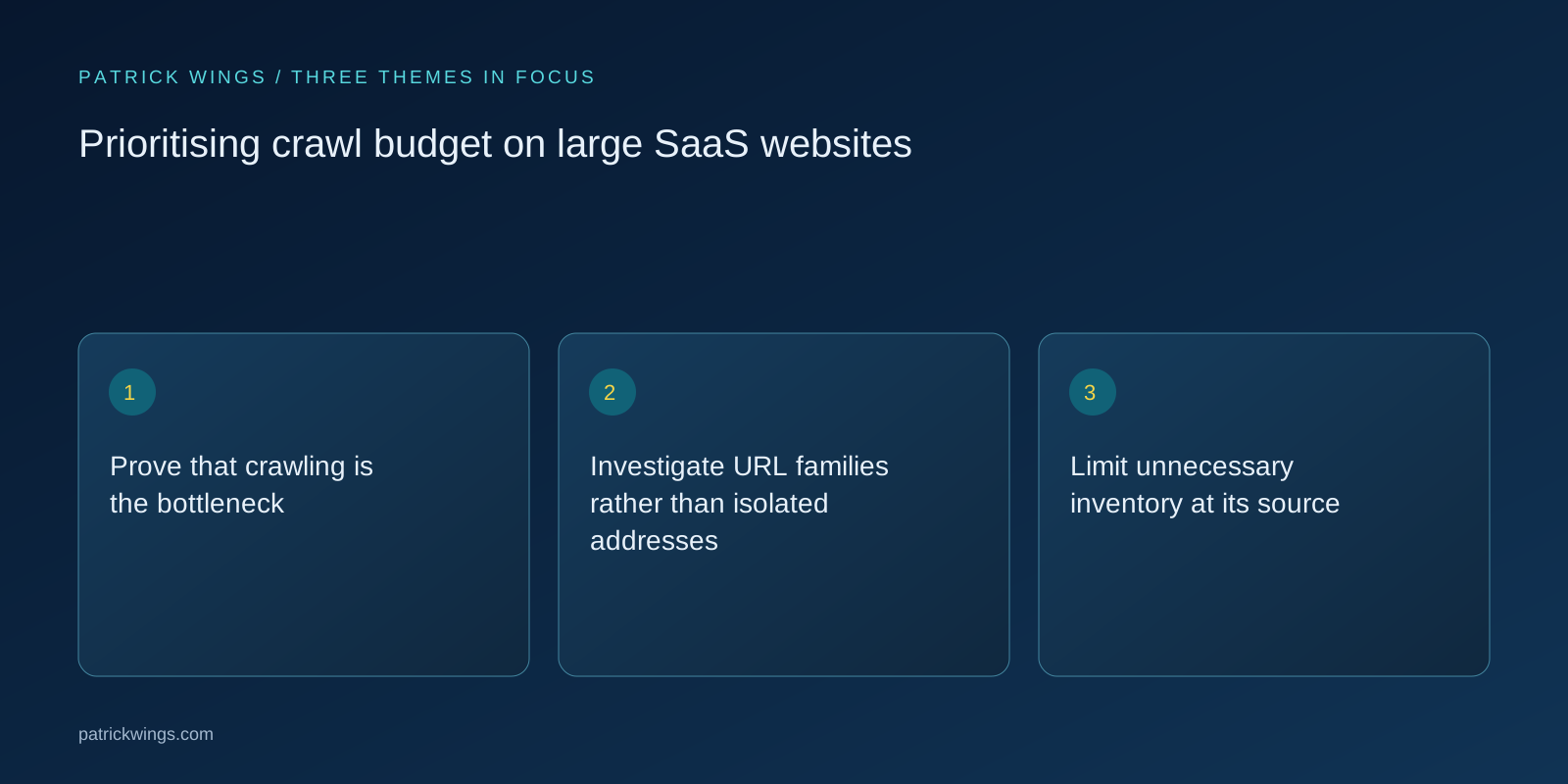
Limit unnecessary inventory at its source
First stop generating and linking unnecessary variations. Standardise parameter order where appropriate and remove session identifiers from public links. Canonicals support consolidation but do not reliably prevent fetching. Noindex also requires the crawler to retrieve the instruction. If an entire area should permanently remain uncrawled, assess a targeted robots.txt rule. Confidential material requires real access controls regardless of crawler policy. Test any proposed block against essential scripts and valuable public pages before releasing the rule into production.
Investigate server health deliberately
Examine response times, error spikes and rate limits for verified crawler traffic. Overload and repeated server failures can constrain crawl capacity. Check caching behaviour and expensive database queries on frequently visited templates. However, a faster application does not automatically generate demand for every document. Tie infrastructure work to an observed constraint. Agree which response classes and observation periods you will compare beforehand, so a temporary change in traffic does not masquerade as a durable operational improvement.

Consider a hypothetical SaaS marketplace
Suppose a fictional integration marketplace has valuable integration profiles but also produces countless sorting and filtering combinations. Logs show most fetches going to those combinations while new profiles are discovered late. The team limits generated paths, improves links to profiles and maintains their sitemap. It then reviews the distribution of fetching again. This example describes a possible investigation rather than a measured client result, and it promises no particular indexing acceleration within a fixed number of days.
Read measurements with their limitations
Track useful fetches, new errors, time to first fetch and access to updated material. The absolute number of bot visits is not a success target. Fewer requests for redundant pages can be beneficial even when total crawling declines. Conversely, frequent fetching does not prove meaningful visibility. Compare similar time windows and account for launches, migrations and outages. State missing log coverage explicitly, including cases where a CDN serves requests that never appear in origin server logs.
Establish an ongoing inventory policy
For every new template, define whether it should be public, crawlable and eligible for search results. Add tests for empty filters, invalid parameters and excessively deep paths. Recheck representative samples after major releases. Judge the outcome by reliable access to valuable content and bounded unnecessary paths. Avoid broad temporary blocks intended merely to redirect crawling elsewhere. A useful policy supports defensible URL decisions and evolves as the website introduces new features, markets and resource types. Explore this further in the guide Technical SEO for SaaS websites: what to check first.
INTERACTIVE / FROM READING TO ACTION
Three checkpoints for your implementation
Choose a checkpoint and track your reading progress. Checks are neither saved nor sent and do not score your business.
CHECKPOINT 01
Limit unnecessary inventory at its source
First stop generating and linking unnecessary variations.
Explore in the article ↗CHECKPOINT 02
Investigate server health deliberately
Examine response times, error spikes and rate limits for verified crawler traffic.
Explore in the article ↗CHECKPOINT 03
Consider a hypothetical SaaS marketplace
Suppose a fictional integration marketplace has valuable integration profiles but also produces countless sorting and filtering combinations.
Explore in the article ↗Frequently asked questions
Does every SaaS site need crawl budget work?
No. First examine inventory size, change frequency and actual delays.
Does noindex save fetches?
The instruction must first be fetched; it is not a general crawling prevention mechanism.
Are more bot visits always better?
No. Reliable access to useful content matters more.
How can I put “Prove that crawling is the bottleneck” into practice?
Compare publication times with the first observed fetch and subsequent indexing state. Use server logs, your sitemap and Search Console together. A page that has been fetched but remains outside the index does not automatically have a crawl budget problem.
What matters when working on “Investigate URL families rather than isolated addresses”?
Group URLs by template and parameters: integrations, documentation, resources, filters, internal search and account areas. Count possible combinations as well as existing pages. A calendar that generates arbitrarily distant months can create a practically unlimited space.