
THE SHORT ANSWER
Develop retargeting creative from unresolved objections and relevant evidence.
For the broader picture of how target customers, channels and sales handoffs work together, read the pillar guide B2B demand generation: from attention to qualified pipeline.
Objections rather than repetition
Develop retargeting creative from unresolved objections and relevant evidence. Someone who already knows the product page often needs more than another general capability claim. Useful answers concern implementation, economics, collaboration or risk, and connect clearly with the offer that person actually researched.
Technical feasibility requires different evidence from project collaboration. Write the objection in buyer language where possible. An internal label such as trust is too broad to produce a useful advert or a destination whose answer can actually be checked.
Derive proof from real questions
Collect real questions from sales conversations, lost opportunities and landing-page feedback. Separate lack of understanding from lack of trust and lack of priority. Match each objection to verifiable evidence: a delivery process, a carefully bounded customer example, technical documentation or transparent prerequisites for the offer.
For each proof point, state what it establishes and what it does not. A process explains collaboration, not a particular saving. A customer story demonstrates one context; it cannot guarantee the same result for every prospect operating under different conditions.
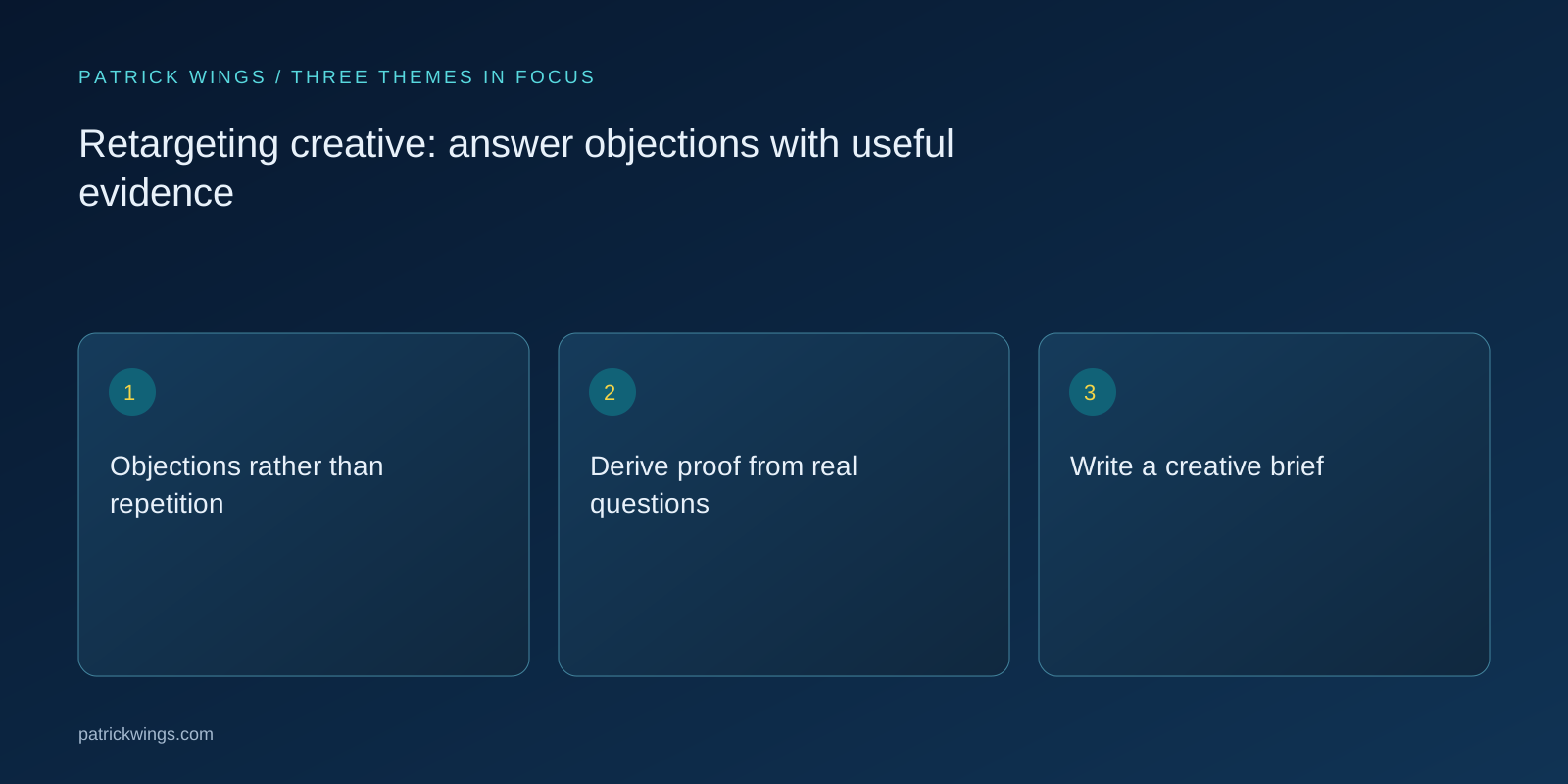
Write a creative brief
Create a brief covering audience, objection, main claim, evidence and destination. The visual should clarify the claim and the landing page must substantiate it. Test different kinds of proof before spending time on colour variations or different crops of the same unsupported assertion. Explore this further in the guide B2B ad fatigue: diagnose before replacing creative.
The brief also needs a clear transition from advert to destination. Someone expecting an integration checklist should find it immediately. Several generic product sections make it difficult to determine whether weak response reflects unsuitable evidence or simply poor access to the promised resource.
Implementation as a test case
A hypothetical software supplier loses conversations because implementation effort remains unclear. It tests a concrete project sequence against its general demo message. If four suitable project conversations result instead of two, the team examines cases and exposure. Those small counts justify further investigation, not a universal performance promise.
The supplier also examines questions in the four project conversations. If implementation is now understood but data security remains unresolved, that suggests another substantive resource. Merely recolouring the same advert would not directly answer the uncertainty that still prevents progress.

Do not overinterpret logos and clicks
A familiar customer logo does not establish relevance to a particular use case without context. High click-through rates do not demonstrate that an objection was resolved either. Avoid unsupported guarantees and customer outcomes stripped of their conditions. A narrower honest statement may help suitable buyers more than a dramatic claim.
Check every numerical claim for period, denominator and approval. Savings from a specific workflow should not become universal product performance. Without reliable figures, a concrete explanation of conditions and delivery often helps more than an artificially precise outcome statistic.
Verify resolved uncertainty
Ask in subsequent conversations which uncertainty the material resolved and what remains unanswered. Compare destination behaviour, quality and repeated exposure. If a creative generates curious clicks but unsuitable expectations, clarify its message before commissioning additional variants that would reproduce the same misunderstanding.
Ask whether the buyer encountered the evidence and which decision it helped. A brief voluntary question offers more context than click counts alone. Individual responses remain qualitative indications and should not be extrapolated to everyone reached without an appropriate evidence base.
Maintain an evidence register
Maintain a shared evidence register with sales and subject specialists. Record approval, currency and scope. When the product changes, check related adverts and destinations together so a previously effective message does not continue promising a process or capability that the company now delivers differently.
Record evidence owner, usage permission, last review and affected adverts. If permission expires or the process changes, the team can locate the right creative. Without this connection, obsolete communication often remains active after specialists have already corrected the underlying material. Explore this further in the guide Campaign retrospectives: turn results into testable changes.
INTERACTIVE / FROM READING TO ACTION
Three checkpoints for your implementation
Choose a checkpoint and track your reading progress. Checks are neither saved nor sent and do not score your business.
CHECKPOINT 01
Write a creative brief
Create a brief covering audience, objection, main claim, evidence and destination.
Explore in the article ↗CHECKPOINT 02
Implementation as a test case
A hypothetical software supplier loses conversations because implementation effort remains unclear.
Explore in the article ↗CHECKPOINT 03
Do not overinterpret logos and clicks
A familiar customer logo does not establish relevance to a particular use case without context.
Explore in the article ↗Frequently asked questions
What counts as suitable evidence?
Something verifiable that addresses the objection and states its conditions.
Test design or message first?
First establish whether the buyer question and type of evidence are appropriate.
How should customer examples be used?
With permission, context and clear limits rather than a general result guarantee.
How can I put “Objections rather than repetition” into practice?
Develop retargeting creative from unresolved objections and relevant evidence. Someone who already knows the product page often needs more than another general capability claim. Useful answers concern implementation, economics, collaboration or risk, and connect clearly with the offer that person actually researched.
What matters when working on “Derive proof from real questions”?
Collect real questions from sales conversations, lost opportunities and landing-page feedback. Separate lack of understanding from lack of trust and lack of priority. Match each objection to verifiable evidence: a delivery process, a carefully bounded customer example, technical documentation or transparent prerequisites for the offer.