
THE SHORT ANSWER
A campaign retrospective turns experience into the next testable decision. It is neither a success presentation nor an unrestricted list of improvement ideas. Start with the original assumption and establish whether execution and evidence actually allow you to assess it. Useful changes follow from that distinction.
For the broader picture of how target customers, channels and sales handoffs work together, read the pillar guide B2B demand generation: from attention to qualified pipeline.
Recover the original hypothesis
Open the brief, goal definition, approved offer and original test plan. State in one sentence what change was expected for which audience and how you intended to recognise it. When documentation is missing, label the reconstruction as retrospective. A later definition of success must not appear to have applied from the beginning. Separate the commercial objective, observable intermediate step and technical delivery task. A properly delivered campaign can test an unsuitable offer assumption, while a technically broken campaign may provide no meaningful test of that assumption at all. Establishing this distinction first prevents a discussion about execution faults from becoming an unsupported judgement about the whole channel. Explore this further in the guide B2B paid media experiments with clear decision rules.
Create a shared event timeline
Place launch, targeting changes, budget adjustments, creative approvals, form problems and sales changes in chronological order. Record the scope of delivery affected by each event. Use a shared data snapshot and identify outstanding CRM qualification. With long sales cycles, completed and still-open outcomes may coexist. Distinguish when an event happened from when somebody recorded it. Include buyer questions that help explain how the offer was understood or misunderstood. The timeline should enable specific alternative explanations. A collection of dashboard screenshots often describes differences without showing their sequence, scope or relationship to a known change in campaign handling.
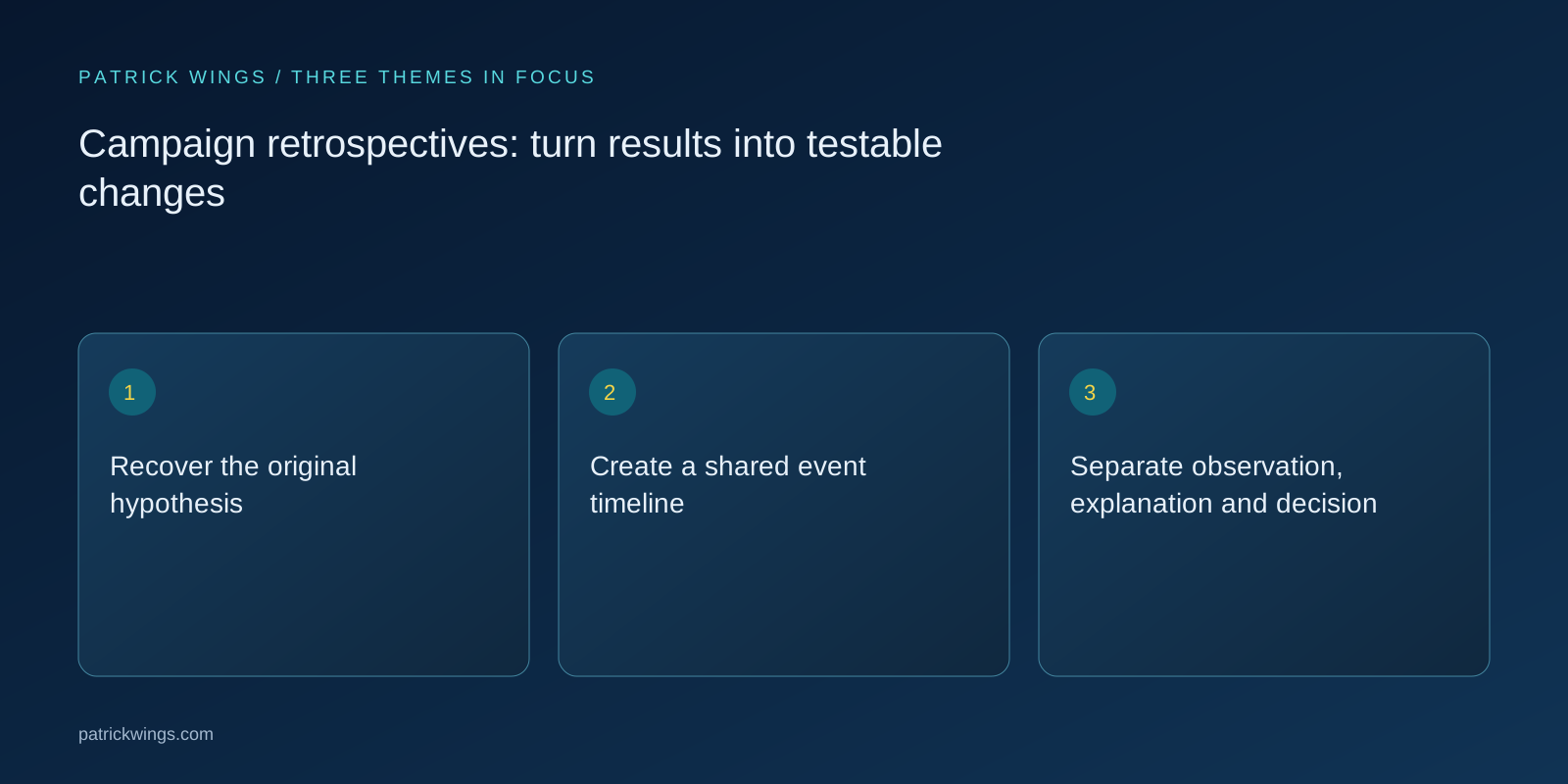
Separate observation, explanation and decision
Write down observed findings first. Then collect possible explanations and the counterevidence relevant to each. Only after that choose an action. Falling submission quality might reflect broader delivery, a confusing promise or changed qualification. Those explanations require different checks. Avoid conclusions such as LinkedIn does not work when you examined only one combination of offer and audience. Give each conclusion a time and scope limit. Uncertainty is an acceptable result when available cases cannot distinguish several plausible explanations. This keeps a confident narrative from becoming a permanent operating rule before the underlying mechanism has actually been investigated.
Unpack a hypothetical result
An invented supplier sees more downloads but fewer suitable introductory conversations. The timeline reveals that revised form copy now presents a free guide as though it were a consultation. Sales reports mismatched expectations. The team chooses a clearer offer description and a focused check of the type of contact people expect. It does not immediately change every audience and bid. This is a bounded diagnostic example, not a claimed effect of the later correction. The change must be assessed through understood expectations and suitable conversations rather than download growth alone or an explanation that merely sounds persuasive during the retrospective meeting.

Choose a small number of testable actions
Give every action an owner, specific object, expected observation and review date. Rather than improve creative, specify answering a technical objection with a verified integration explanation and collecting the questions it generates. Separate immediate repairs, new experiments and research needs. A repair restores functionality; it does not automatically establish the commercial effect of a new strategy. Limit simultaneous changes so execution remains controllable. Record justified decisions against changing something too. Otherwise the next team may repeat the same unresolved discussion without additional information, while old recommendations accumulate and compete with work that could actually resolve the identified constraint. Explore this further in the guide Marketing pipeline review: ask the right questions with sales.
Connect the next review to these decisions
Begin the next retrospective with previously agreed actions. Was the change delivered, was observation time sufficient and did collection follow the former definition? Retain failed and inconclusive attempts alongside positive findings. Google Ads experiments can support different testing tasks, but the retrospective still needs to explain your specific commercial question. A useful output is a short decision record with evidence and limits rather than a long presentation without a next action. Marketing and sales jointly confirm which cases require further qualification and who owns the next substantive check. The record should make subsequent disagreement investigable instead of relying on everybody remembering the same meeting differently.
INTERACTIVE / FROM READING TO ACTION
Three checkpoints for your implementation
Choose a checkpoint and track your reading progress. Checks are neither saved nor sent and do not score your business.
CHECKPOINT 01
Separate observation, explanation and decision
Write down observed findings first.
Explore in the article ↗CHECKPOINT 02
Unpack a hypothetical result
An invented supplier sees more downloads but fewer suitable introductory conversations.
Explore in the article ↗CHECKPOINT 03
Choose a small number of testable actions
Give every action an owner, specific object, expected observation and review date.
Explore in the article ↗Frequently asked questions
What belongs in a campaign retrospective?
The hypothesis, execution, data maturity, alternative explanations and a few testable follow-up actions.
Must every retrospective produce changes?
No. Further observation or a justified decision to retain the current approach can be appropriate.
How do we prevent retrospective success criteria?
Preserve the original test plan and explicitly label questions added after results became available.
How can I put “Recover the original hypothesis” into practice?
Open the brief, goal definition, approved offer and original test plan. State in one sentence what change was expected for which audience and how you intended to recognise it. When documentation is missing, label the reconstruction as retrospective.
What matters when working on “Create a shared event timeline”?
Place launch, targeting changes, budget adjustments, creative approvals, form problems and sales changes in chronological order. Record the scope of delivery affected by each event. Use a shared data snapshot and identify outstanding CRM qualification.