
THE SHORT ANSWER
Investigate pipeline velocity through individual transitions rather than one overall average.
For the broader picture of how target customers, channels and sales handoffs work together, read the pillar guide B2B demand generation: from attention to qualified pipeline.
Treat velocity as a transition question
Investigate pipeline velocity through individual transitions rather than one overall average. Fast initial contact is of little help if suitable projects then remain unresolved. Separate waiting time, active work and substantive reasons so improvements address the actual constraint rather than whichever timestamp is easiest to measure. Explore this further in the guide Marketing pipeline review: ask the right questions with sales.
Decide whether you want to improve movement into technical review, proposal or approval. An overall first-contact-to-close average obscures these tasks. A useful investigation starts with the entry conditions of neighbouring stages and the information that actually permits a case to move from one to the other.
Capture stage entries and waiting time
Define entry and exit for every stage examined. Keep the current age of open cases separate from completed durations. HubSpot documents several time-in-stage properties with different conditions; verify their meaning before automatically using one field for both unresolved cases and historical completed transitions.
Store the relevant stage entry, exit and confirmed waiting reasons for each opportunity. Separate unfinished cases from completed transitions. Repeated backward and forward moves require an explicit rule. Without event history, a current-stage list cannot explain how long a project really waited for a particular prerequisite or which change ended that wait.
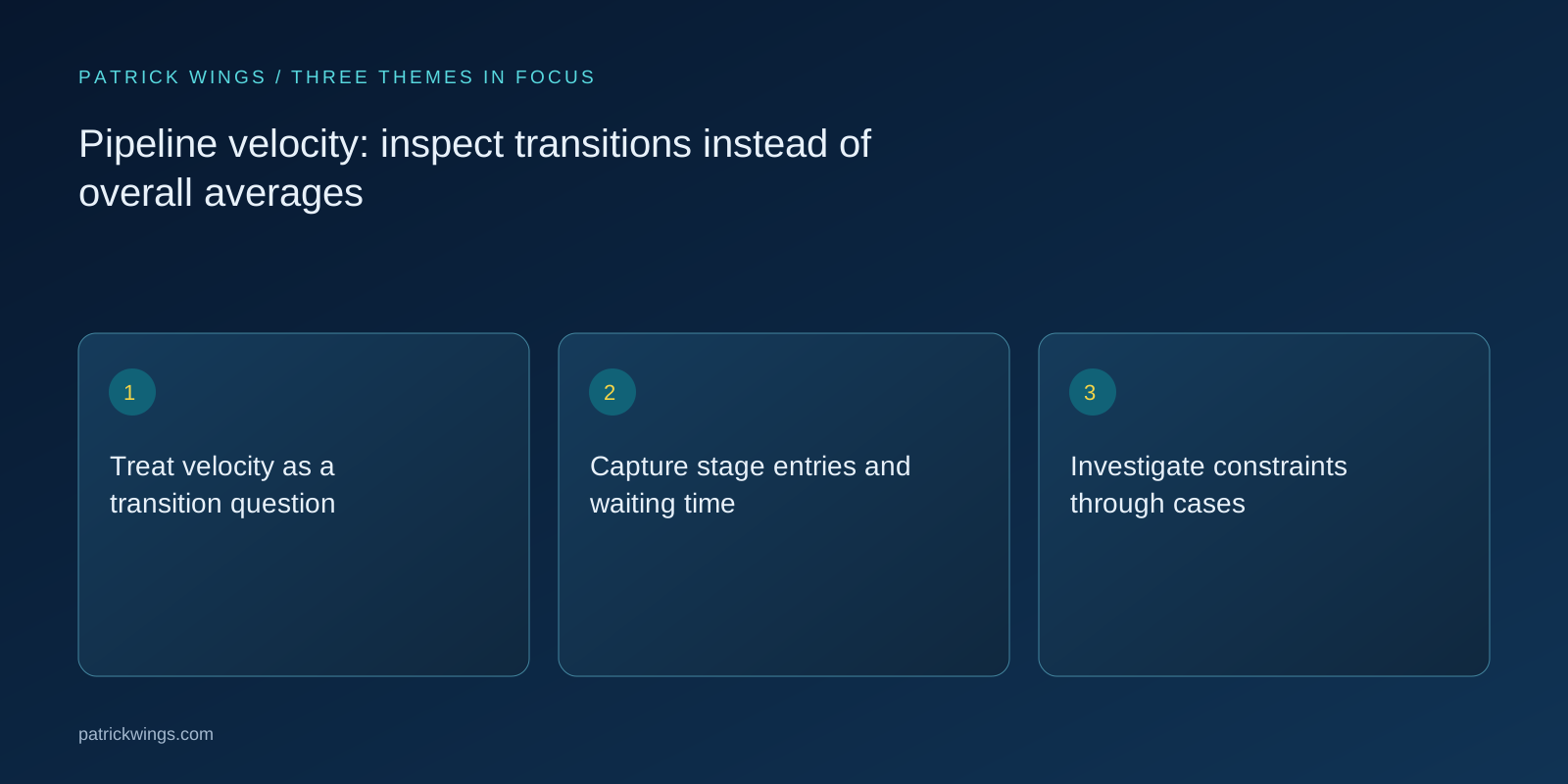
Investigate constraints through cases
Group cases by transition, offer and handling team. Show the distribution and counts alongside the average. Review selected long and short cases with sales. Add reasons such as security review, budget approval or missing stakeholders rather than immediately attributing every long duration to poor sales effort.
Read several waiting cases with their account owners. Ask about missing evidence, named decision participants and agreed customer steps. Distinguish a necessary internal customer review from a question your own team has not answered. Only the latter can be directly addressed through clearer ownership or faster specialist delivery without making assumptions about the customer’s timetable.
Interpret two different delays
In an invented pipeline, four projects take ten, twelve, fourteen and eighty-four days to reach proposal. The average is thirty days and conceals one outlier. Case review reveals an external security approval. Faster form response would not resolve that particular constraint; suitable security documentation might help instead.
In the hypothetical example, security assessment and unclear specialist ownership need different responses. A complete dossier may assist security review; a named contact is needed for responsibility. A general request to shorten sales cycles does not explain which obstacle will disappear or which customer dependency still needs to be accommodated realistically in the plan.

Recognise selection-driven acceleration
Analysing only won deals excludes long-running open and lost cases. Closing an opportunity prematurely shortens measured duration without improving the business. Different stage definitions across teams can also create apparent speed differences without indicating that buyers receive a materially different experience or that one team works less effectively.
Removing old complex cases can lower average duration without making any remaining project move faster. Check the case mix and excluded opportunities. Describe cleanup explicitly as cleanup. A move towards smaller offers changes the business mix; it does not automatically demonstrate better handling of comparable projects or resolution of the original bottleneck.
Review progress alongside open cases
After an intervention, check whether the affected transition becomes faster while later quality remains intact. Watch for waiting time moving into the next stage. Speed is not an end in itself: complex decisions may need legitimate review that reduces later misfit and prevents avoidable implementation problems.
Compare time to transition for similar projects while also showing the proportion still waiting. Measuring completed winners alone overlooks blocked cases. For each constraint, record which prerequisite has now been fulfilled. This reveals substantive movement better than one average that excludes the longest open cases from its calculation altogether.
Assign workable prerequisites
Connect each constraint with an action somebody can influence. Marketing can provide evidence, sales can clarify next steps and specialists can prepare reviews. Record uncontrollable waiting time too, enabling the pipeline discussion to distinguish practical improvements from unrealistic demands to accelerate the customer’s internal purchasing process. Explore this further in the guide Sales capacity: match campaigns to actual follow-up capacity.
A specialist owner maintains technical evidence, while the account owner clarifies customer steps. Marketing develops reusable help for recurring questions. Subsequently check whether that specific prerequisite is missing less often. A larger content library does not establish faster progression when the relevant material still fails to reach the conversation where it is needed.
INTERACTIVE / FROM READING TO ACTION
Three checkpoints for your implementation
Choose a checkpoint and track your reading progress. Checks are neither saved nor sent and do not score your business.
CHECKPOINT 01
Investigate constraints through cases
Group cases by transition, offer and handling team.
Explore in the article ↗CHECKPOINT 02
Interpret two different delays
In an invented pipeline, four projects take ten, twelve, fourteen and eighty-four days to reach proposal.
Explore in the article ↗CHECKPOINT 03
Recognise selection-driven acceleration
Analysing only won deals excludes long-running open and lost cases.
Explore in the article ↗Frequently asked questions
Is average sales-cycle length enough?
No. Transitions, distributions and open cases explain where time accumulates.
Are long deals bad?
Not necessarily; inspect scope, necessary approvals and actual progress.
Which cases should be reviewed?
Short, typical, long and unresolved cases at the transition being investigated.
How can I put “Treat velocity as a transition question” into practice?
Investigate pipeline velocity through individual transitions rather than one overall average. Fast initial contact is of little help if suitable projects then remain unresolved. Separate waiting time, active work and substantive reasons so improvements address the actual constraint rather than whichever timestamp is easiest to measure.
What matters when working on “Capture stage entries and waiting time”?
Define entry and exit for every stage examined. Keep the current age of open cases separate from completed durations. HubSpot documents several time-in-stage properties with different conditions; verify their meaning before automatically using one field for both unresolved cases and historical completed transitions.