
THE SHORT ANSWER
A useful B2B FAQ begins with a genuine question rather than a marketing statement rewritten as a question. For SaaS and IT offers, relevant questions often appear in sales conversations, support requests and implementation work. Editorial practice turns them into a manageable question backlog and precise answers. This guide covers the ownership and quality of those answers. Technical markup, search presentation and answer modules are complementary tasks, not substitutes for subject-matter accountability.
To see how this step fits into your content strategy, read the pillar guide B2B content marketing: From useful expertise to qualified demand.
Collect questions with their real context
Gather anonymized questions from actual contacts and record the situation: who needed to decide what, and which information was missing? Original wording can reveal the terms readers use. Remove unnecessary personal or confidential details. One unusual question does not automatically deserve a prominent FAQ entry, but it may reveal an important ambiguity. Separate recurring questions from internal topic wishes. Even a frequent question needs an editorial placement decision. It may belong on this page, elsewhere in the journey or in the main explanation rather than a separate FAQ that compensates for missing core information. Explore this further in the guide Turning sales questions into a searchable editorial library.
Maintain an editorial question backlog
For each question, start with the topic, source situation, possible destination, subject owner and status. Add the decision the answer should support. Merge similar wording when it genuinely expresses the same meaning. Do not combine distinct questions simply because they share keywords. “How does implementation begin?” differs from “How long does implementation take?” The backlog is a working tool, not an automatic publication list. It can contain open research, unsuitable questions and points that cannot currently be answered responsibly. This lets the team manage uncertainty without turning every internal idea into another public entry.
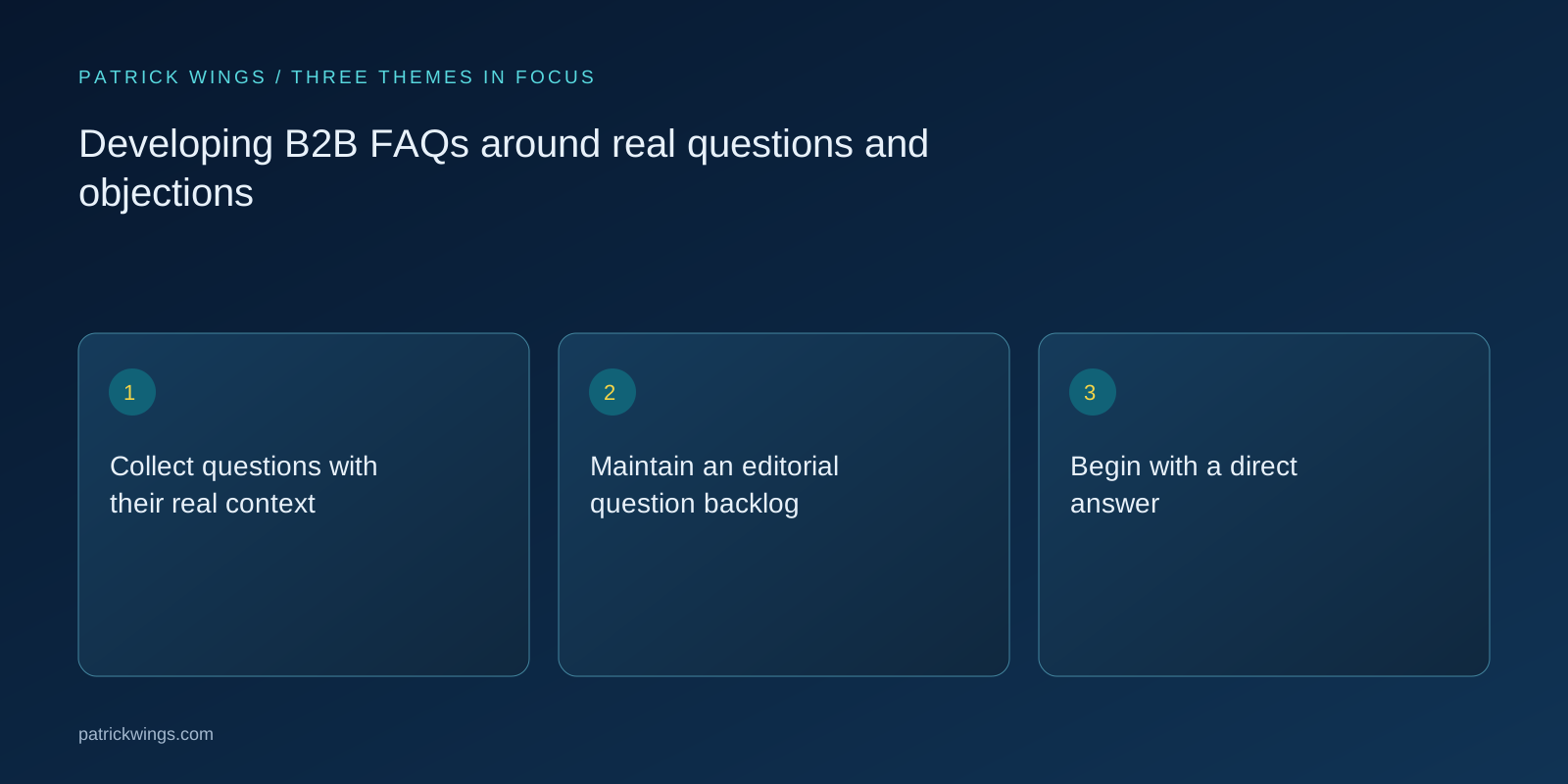
Begin with a direct answer
Answer the question first, then add conditions, boundaries and a useful next link. Where the answer depends on individual circumstances, identify the decisive factors. “It depends” without an explanation does little to help. Avoid placing a company introduction before the actual answer. Explain specialist terminology when the intended reader may not know it. The answer should remain understandable outside its decorative layout. Name its subject clearly and include enough context that quoting or forwarding it does not easily change the meaning or remove an essential condition that made the statement accurate.
A hypothetical FAQ revision
Imagine an IT consultant frequently being asked whether an audit includes implementation. The first draft says only that the team provides comprehensive support. A clearer answer explains that the described audit delivers findings and prioritized recommendations, while implementation is separately agreed. The responsible specialist checks that boundary against the actual offer. A link leads to the scope description. This hypothetical example illustrates the editorial task: resolving a real uncertainty. It does not establish an industry standard and should not be copied when another provider’s offer includes different activities, deliverables or contractual commitments. Explore this further in the guide Service pages that make scope and collaboration concrete.

Treat subject acceptance as a distinct check
The responsible expert should confirm that the answer addresses the question accurately and sufficiently, rather than merely approving its tone. Record essential conditions and claims that must not be made. Pricing, contractual commitments and technical capabilities may require additional reviewers. An entry is ready only when the question, answer and linked offer agree. Keep approval and review dates in the internal working record. That makes later changes traceable without burdening the public FAQ with unnecessary process detail. A friendly editorial voice cannot compensate for an answer whose underlying scope has never been verified.
Check placement and language with readers
Place questions where they support a specific decision. A general collection can supplement service pages, but it cannot replace every explanation at the point of need. Ask relevant people whether they recognize the question and whether the answer resolves the uncertainty they expected. German and English versions must preserve meaning even when wording differs. Pay particular attention to distinctions between requests, bookings, advice and implementation. Translation should not turn a bounded statement into a broader commitment. Add meaningful feedback to the backlog so future editors can understand the reason for a change.
Plan maintenance and unresolved questions
Connect FAQ review to changes in the offer, product and delivery process. Repeated questions after publication may show an incomplete answer or poor placement. An unanswered question should have an internal owner and a next research step. Do not invent precision simply to close an editorial gap. Where a dependable answer is not yet possible, explain which information is needed for individual clarification. FAQ quality comes from supportable answers and maintenance, not the largest possible number of entries. Technical discoverability and markup should be checked separately against the visible content and current platform guidance.
INTERACTIVE / FROM READING TO ACTION
Three checkpoints for your implementation
Choose a checkpoint and track your reading progress. Checks are neither saved nor sent and do not score your business.
CHECKPOINT 01
Begin with a direct answer
Answer the question first, then add conditions, boundaries and a useful next link.
Explore in the article ↗CHECKPOINT 02
A hypothetical FAQ revision
Imagine an IT consultant frequently being asked whether an audit includes implementation.
Explore in the article ↗CHECKPOINT 03
Treat subject acceptance as a distinct check
The responsible expert should confirm that the answer addresses the question accurately and sufficiently, rather than merely approving its tone.
Explore in the article ↗Frequently asked questions
Where do useful B2B FAQ questions come from?
From identifiable buying, support and delivery situations. Record the question alongside the decision it should support.
Who should approve answers?
A responsible subject expert, with additional offer, technical or contractual owners where the claim requires them.
How many FAQs does a page need?
Enough to address relevant unresolved questions. A fixed count does not replace judging usefulness and placement.
How can I put “Collect questions with their real context” into practice?
Gather anonymized questions from actual contacts and record the situation: who needed to decide what, and which information was missing? Original wording can reveal the terms readers use. Remove unnecessary personal or confidential details.
What matters when working on “Maintain an editorial question backlog”?
For each question, start with the topic, source situation, possible destination, subject owner and status. Add the decision the answer should support. Merge similar wording when it genuinely expresses the same meaning.