
THE SHORT ANSWER
A mention in an AI answer is not a website visit, and a visit is not yet a sales opportunity. GEO and AEO therefore require several distinct measurements. Their relationship helps establish whether visibility matters to your business. Credible reporting explicitly describes which platforms and situations are covered and which remain outside the available data.
For the broader picture of technical foundations, useful content and visibility measurement, read the pillar guide SEO, GEO and AEO for SaaS: visibility that supports buying decisions.
Define the question before building the dashboard
Do you want to know whether your brand appears in a category, whether expert articles are used as sources or whether suitable enquiries result? Those questions need different data. Give each metric a definition, source and interpretation boundary. A visible brand mention may contain no link. A linked citation may receive no click. An enquiry may follow several prior interactions. Preserve those distinctions in the report rather than merging them into an apparently definitive overall score that hides how the numbers were produced.
Use platform reports within their actual coverage
Bing Webmaster Tools offers an AI Performance report covering measures such as citations and cited pages. These are not click counts or a universal ranking. Also inspect the reports currently available in your Google Search Console property; Google now documents a generative AI performance report. Availability, minimum data requirements and platform coverage may vary. Record which report you actually use. Do not automatically add numbers from different systems because their definitions and included search experiences can differ, even when the labels appear similar.
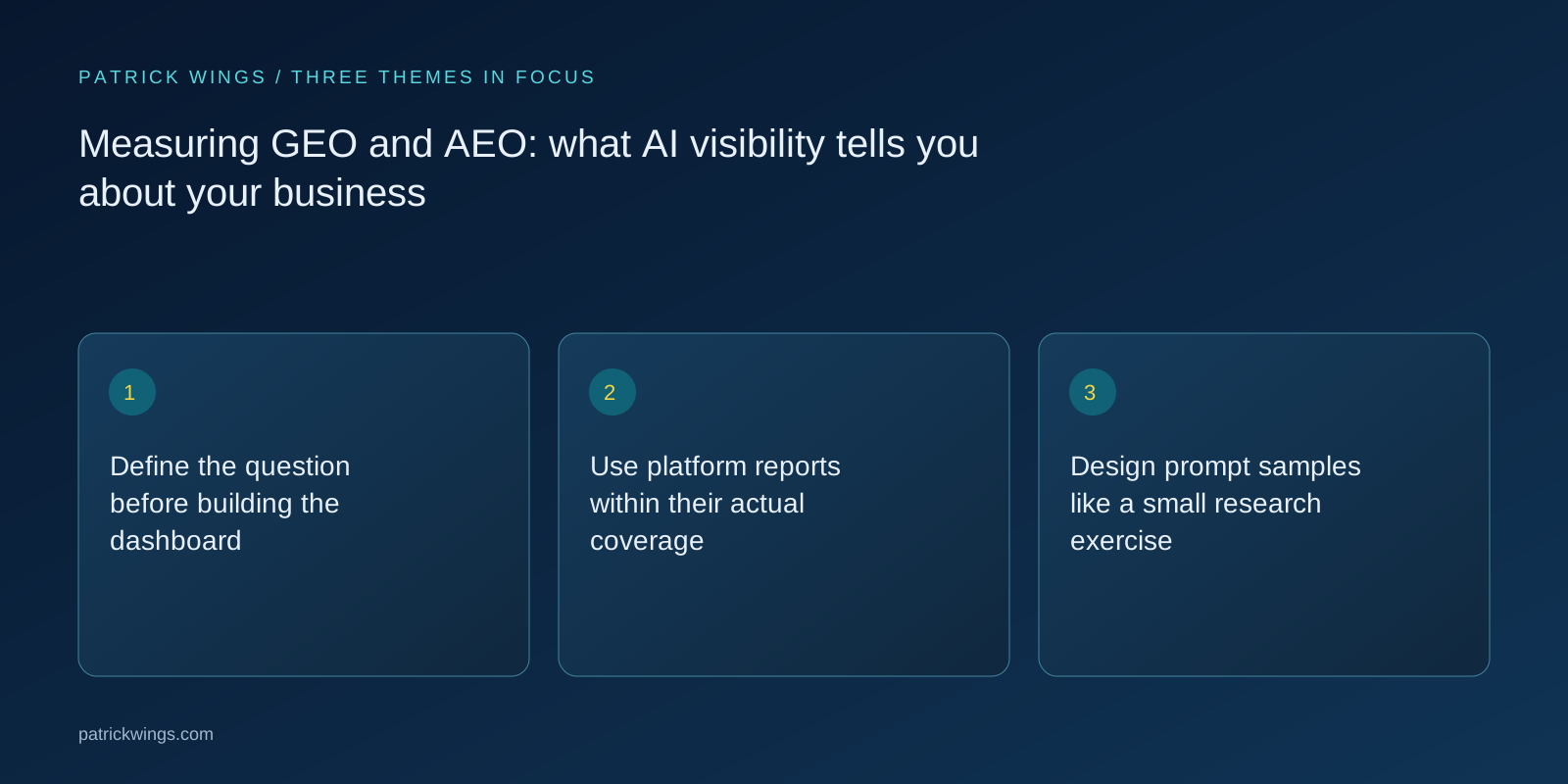
Design prompt samples like a small research exercise
Select questions from real buying situations: understanding a problem, exploring approaches, comparing providers and checking requirements. Define language, target market, system and observation date. Record the question and observed answer with source links when available. Repeat through a consistent procedure and interpret changes cautiously. The result describes your sample, not every question users ask. A single positively framed prompt that already names your brand is weak evidence of visibility during an unbiased supplier search. Explain those limits alongside any trend chart. Explore this further in the guide SaaS keyword strategy: turn searches into useful pages.
Add measurable visits and CRM quality
Inspect identifiable referrals from AI platforms in your web analytics and connect relevant sessions with meaningful actions. Mark remaining gaps because not every visit carries an unambiguous source. Ask new contacts how they discovered you as an additional signal. Voluntary free-text answers provide context but are not perfect attribution either. Assess enquiries by customer fit and actual need. A few suitable conversations can matter more commercially than many visits unrelated to the offer. Report that distinction so the team does not optimise visibility at the expense of relevance.

Change factors in ways you can reasonably interpret
If you change content, navigation, domain and tracking simultaneously, subsequent movement becomes difficult to explain. Record major publications and technical changes. For bounded tests, use comparable pages or a clearly defined subject area. Even then, the environment is not constant: demand and platforms change. Describe findings as observations with plausible explanations. Avoid concluding that a new FAQ caused every subsequent citation. Timing is a reason to investigate a relationship, not proof of one. This caution protects useful learning rather than preventing experimentation.
Establish a short, decision-focused review
A practical review asks what changed, which explanation is plausible, how strong the evidence is and what action should follow. Separate technical faults, content gaps and normal variation. Do not publish a seemingly exact visibility percentage without defining the population and method. Use the same discipline with sales and management. The objective is not an attractive chart but a better decision about the information you should improve and the customer situations you should cover next. A smaller, well-defined dataset is often easier to act on than a large ambiguous one. Explore this further in the guide Technical SEO for SaaS websites: what to check first.
INTERACTIVE / FROM READING TO ACTION
Three checkpoints for your implementation
Choose a checkpoint and track your reading progress. Checks are neither saved nor sent and do not score your business.
CHECKPOINT 01
Design prompt samples like a small research exercise
Select questions from real buying situations: understanding a problem, exploring approaches, comparing providers and checking requirements.
Explore in the article ↗CHECKPOINT 02
Add measurable visits and CRM quality
Inspect identifiable referrals from AI platforms in your web analytics and connect relevant sessions with meaningful actions.
Explore in the article ↗CHECKPOINT 03
Change factors in ways you can reasonably interpret
If you change content, navigation, domain and tracking simultaneously, subsequent movement becomes difficult to explain.
Explore in the article ↗Frequently asked questions
Are AI citations the same as traffic?
No. A citation indicates a source reference. Only an actual measurable visit becomes attributable traffic.
Can we measure complete AI market share?
Not with ordinary prompt samples. You observe defined questions in particular systems and situations, not the whole market.
Which metric should management see?
Show visibility, measurable visits and qualified business outcomes separately, explaining coverage and attribution limits.
How can I put “Define the question before building the dashboard” into practice?
Do you want to know whether your brand appears in a category, whether expert articles are used as sources or whether suitable enquiries result? Those questions need different data. Give each metric a definition, source and interpretation boundary.
What matters when working on “Use platform reports within their actual coverage”?
Bing Webmaster Tools offers an AI Performance report covering measures such as citations and cited pages. These are not click counts or a universal ranking. Also inspect the reports currently available in your Google Search Console property; Google now documents a generative AI performance report.