
THE SHORT ANSWER
Return HTTP statuses that accurately describe an editorial URL: successful content, a genuine replacement, a missing resource or a temporary delivery failure. Choose the response from the content decision rather than from a desire to eliminate every error report. A useful error page and a correct error status serve different but complementary purposes.
For the broader picture of technical foundations, useful content and visibility measurement, read the pillar guide SEO, GEO and AEO for SaaS: visibility that supports buying decisions.
Create a status policy for publishing states
Map draft, published, moved, withdrawn and temporarily unavailable content to intended behaviour. Involve editorial and engineering owners because the CMS state may not automatically produce the right public response. A removed article should not retain a successful status merely because the shared site shell still renders. A new article should not be linked before its route works. Include files, translated versions and legacy aliases in the policy. Store expected examples so people can verify the contract without interpreting a vague instruction to fix broken pages.
Distinguish missing content from replacements
When a page has a genuinely equivalent successor, redirect to that specific useful destination. If nothing appropriate replaces the removed content, an honest not-found or gone response can be correct. Avoid sending every retired article to the homepage: that obscures the reason the original address no longer serves its promise. Preserve a helpful explanation and relevant navigation on the error page without claiming the requested article exists. Search impact needs contextual review, but retaining misleading responses is not a sound substitute for a clear retirement decision.
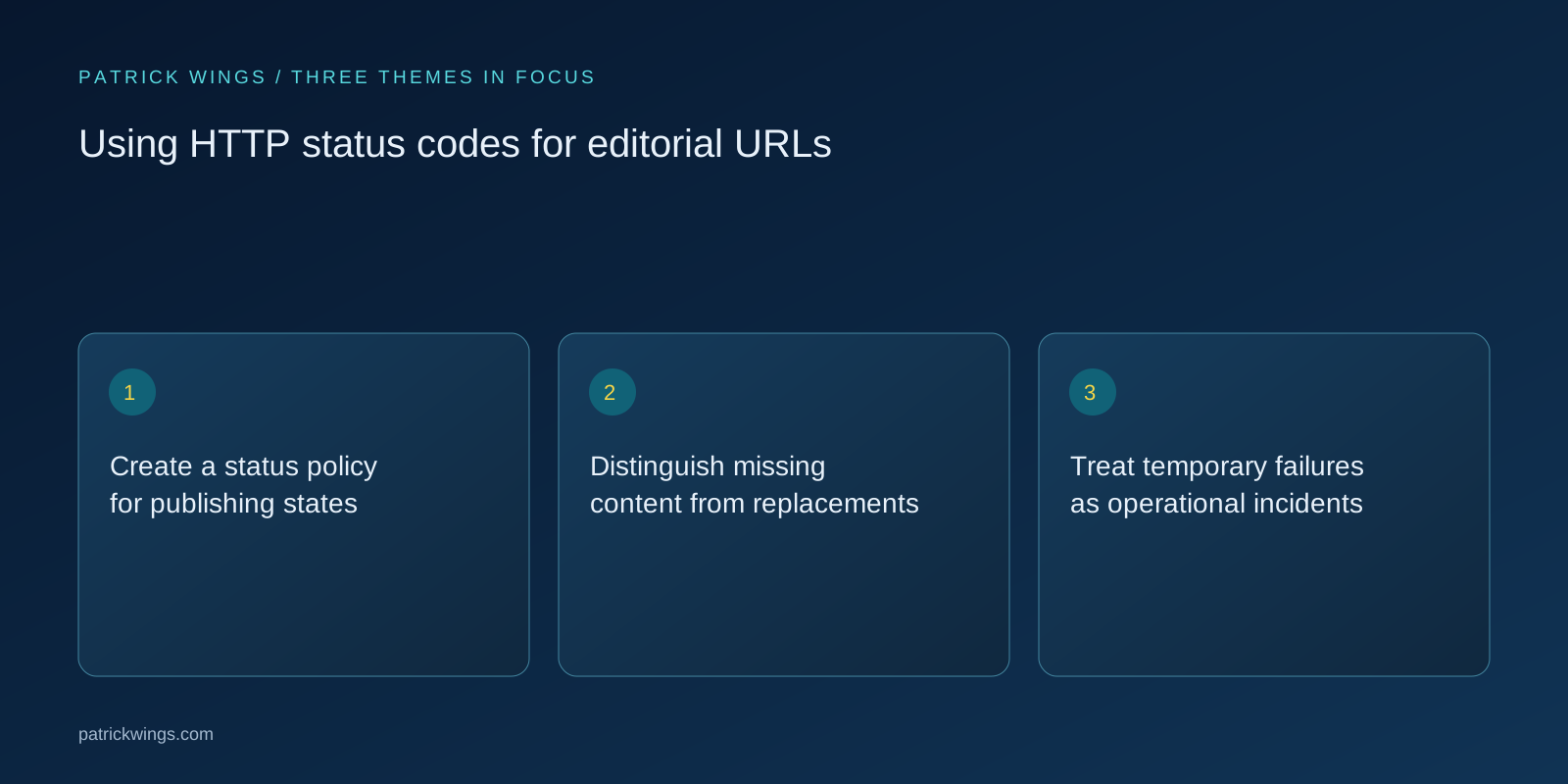
Treat temporary failures as operational incidents
A backend outage or failed content API should not generate an apparently complete successful article with missing information. Choose an appropriate temporary failure response and coordinate incident handling with operations. Investigate whether the CDN caches errors or serves stale pages, and document the intended fallback. Monitor response patterns over time because a single manual refresh can miss intermittent failures. Temporary server errors can affect crawling; the remedy is dependable service and accurate responses, not disguising the outage behind a successful status while the main content remains unavailable.
Test headers and visible output separately
Request representative URLs directly and inspect the actual HTTP response before evaluating the browser view. Follow redirect chains and record each step. Check a valid article, a moved article, a typo, an invalid pagination page and a temporary test failure in a controlled environment. Verify that a custom error page preserves the error status at the original address. Single-page applications and hosting fallbacks can return the same shell for every path, so include unknown routes in release checks rather than testing only addresses listed in the CMS. Explore this further in the guide Testing JavaScript SEO through actual page delivery.

Illustrative example: withdrawing an outdated checklist
Imagine an illustrative checklist describing a discontinued integration. A maintained replacement explains the same task in the current product, so the old guide redirects there after an editorial comparison. A separate event invitation has no comparable successor and receives a useful not-found page. During an unrelated API outage, live guides return the intended temporary failure behaviour. These decisions reflect different meanings, not a universal attempt to minimise error counts. The scenario does not predict ranking recovery or establish a fixed period for search engines to process the changes. Explore this further in the guide Mapping migration redirects by meaning.
Review exceptions by business consequence
Track valuable URLs affected by incorrect responses and assign owners for the underlying cause. Separate deliberate removals from unexpected failures in reporting so operations does not reopen every legitimate not-found case. Recheck important external links and campaign destinations after changes. Review the policy when hosting, routing or CMS state models change. Success means truthful responses, useful destinations and fewer unexpected delivery failures. A low count of reported errors is not sufficient evidence of health if deleted content returns successful empty pages or unrelated redirects hide the loss of an important answer.
INTERACTIVE / FROM READING TO ACTION
Three checkpoints for your implementation
Choose a checkpoint and track your reading progress. Checks are neither saved nor sent and do not score your business.
CHECKPOINT 01
Treat temporary failures as operational incidents
A backend outage or failed content API should not generate an apparently complete successful article with missing information.
Explore in the article ↗CHECKPOINT 02
Test headers and visible output separately
Request representative URLs directly and inspect the actual HTTP response before evaluating the browser view.
Explore in the article ↗CHECKPOINT 03
Illustrative example: withdrawing an outdated checklist
Imagine an illustrative checklist describing a discontinued integration.
Explore in the article ↗Frequently asked questions
Is a 404 always an SEO mistake?
No. It can be the correct response when content is absent and no useful replacement exists.
Why avoid blanket homepage redirects?
They usually do not fulfil the specific intent of the retired URL and can obscure genuine content loss.
Can an error page use the normal design?
Yes. Keep helpful navigation and branding while returning the appropriate error status.
How can I put “Create a status policy for publishing states” into practice?
Map draft, published, moved, withdrawn and temporarily unavailable content to intended behaviour. Involve editorial and engineering owners because the CMS state may not automatically produce the right public response. A removed article should not retain a successful status merely because the shared site shell still renders.
What matters when working on “Distinguish missing content from replacements”?
When a page has a genuinely equivalent successor, redirect to that specific useful destination. If nothing appropriate replaces the removed content, an honest not-found or gone response can be correct. Avoid sending every retired article to the homepage: that obscures the reason the original address no longer serves its promise.