
THE SHORT ANSWER
Inventory quality in B2B display advertising concerns whether an environment suits the offer and enables a meaningful, verifiable interaction. Inexpensive impressions or numerous clicks are insufficient evidence. Connect contextual review with technical usability and the quality of subsequent enquiries. This article provides an operational audit method, not an automatic fraud detector or a universal list of worthwhile websites. Limited transparency, brand risk and weak commercial suitability are different problems and need different decisions rather than a single judgement based on the cost of reaching a large audience.
For the broader connection between paid channels, measurement and economics, read the pillar guide Performance marketing for B2B SaaS: manage channels, measurement and budgets.
Define which quality question needs an answer
Distinguish four questions: does the context suit the brand, is the interaction technically plausible, does the message reach a relevant situation and do suitable subsequent actions occur? A reputable specialist publication can still be unsuitable for your specific buyers. Conversely, an unfamiliar app is not by itself evidence of invalid traffic. State the decision before auditing: constrain certain contexts, investigate a data defect or reconsider the display initiative. A single quality score obscures these distinctions. Involve brand, campaign and analytics owners, but require each role to support its judgement with a concrete observation. Personal preference for familiar publications is not an adequate substitute for a defensible review. Explore this further in the guide YouTube ads for B2B: connect video to a testable demand journey.
Create an inspectable inventory record
Collect available placement details, period, campaign context, expenditure and relevant interactions in a bounded review register. Record which detail the report does not provide. A website name does not explain the actual ad position or attention received. Inspect notable entries through approved procedures and retain screenshots or descriptions only where permitted. Keep observations, interpretations and next checks in separate fields. “Many clicks without demand” then becomes a pattern to investigate rather than an unsupported allegation of fraud. Select examples according to risk and spending significance, not merely because they look unusual in a team chat. A review should explain its sampling choices as well as its findings.
What is invisible in the report?
Write reporting limits beside the analysis. Knowing only a domain name does not establish the exact position, visibility or user interaction. That missing detail limits the conclusion the team may responsibly draw from an inventory entry.
| Finding | Possible explanation | Next check |
|---|---|---|
| Many starts, few completions | Usability issue or unsuitable interest | Test the form under device conditions |
| Inappropriate theme | Brand requirement violated | Check scope of the restriction |
| Brief visits | Context, loading issue or accidental click | Reproducible technical review |
| Unsuitable enquiries | Message, environment or offer | Review anonymised reasons with sales |
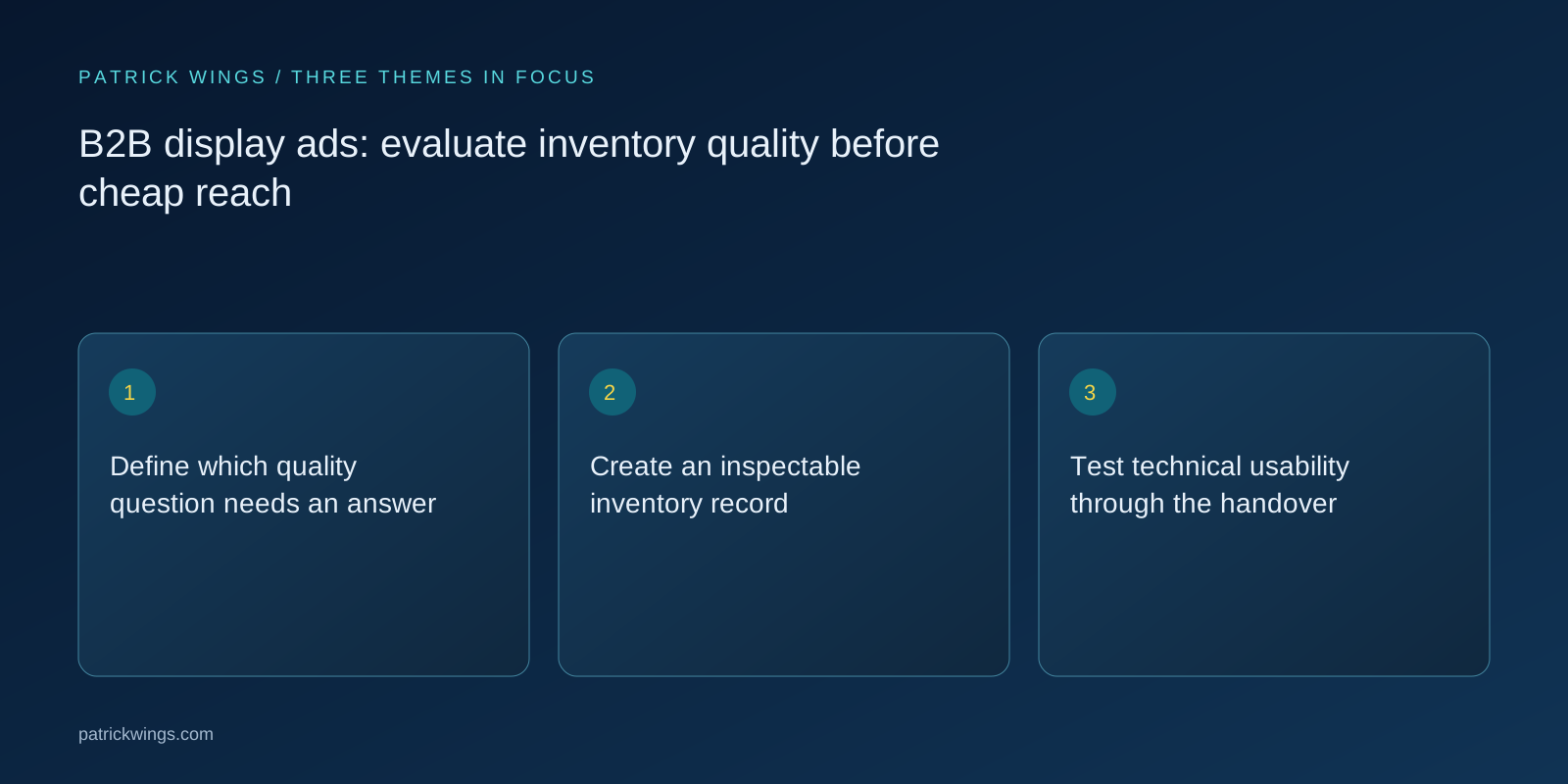
Test technical usability through the handover
Open the advertisement and destination under supported device conditions. Is the message legible, does the link reach the correct page and can a visitor complete the promised action? Difficult mobile form handling can lose relevant visitors without showing that the inventory itself is inappropriate. Treat duplicate events, brief interactions and unusual concentrations as clues requiring further examination. Individual behavioural patterns do not establish automated or fraudulent use. Connect technical findings to a reproducible test and a specified expected state. Repair broken handovers before interpreting remaining placement differences commercially; otherwise website defects may be incorrectly presented as proof that media environments are inherently low quality.
Turn suitability requirements into actual controls
Google documents suitability settings and content exclusions with different coverage. Check which controls apply to your campaign and where limitations remain. Excluding a category does not promise complete visibility into every impression. Describe unsuitable contexts specifically, such as a particular theme or a reviewed placement, and preserve the reason for restriction. Do not import a long exclusion list unquestioningly from another account: it may contain different brand assumptions and obsolete entries. Assign one reviewer to new reports, immediate containment decisions and evidence of the change. Examine whether account-level rules could unintentionally affect other campaigns before rolling out an audit recommendation broadly across the organisation's advertising activity.

Assess commercial fit after the click
Classify permitted enquiry records by supported use case, account fit and desired next step. Examine quality alongside expenditure and observation age without overinterpreting isolated, rare contracts. Unsuitable responses can arise from a broad promise, an attractive but misleading download offer or an inappropriate environment. The diagnosis must distinguish those possibilities. Ask sales to return anonymised descriptions of recurring misunderstandings. A cheap CPL loses its usefulness when handling cost increases and appropriate buyers remain absent. Conversely, a narrow context may produce few but valuable technical conversations. Evaluate the declared purpose of the campaign rather than adopt a universal click-through rate, session duration or enquiry-volume threshold as the meaning of inventory quality.
Follow a fictional inventory investigation
The fictional SaaS company AuditPath observes many mobile form starts but few completed, suitable enquiries during a display pilot. All circumstances are illustrative, not customer results. The team initially suspects unsuitable app placements. A controlled test instead shows that the explanation for a required field is hidden on small screens. After repairing the form, some environments remain excluded for brand-fit reasons while others continue under observation. Repairing the defect proves neither good inventory quality nor a measured revenue improvement. It removes one alternative explanation so later analysis becomes more informative. The scenario shows why technical function, suitability and demand quality need separate review assignments instead of being reduced to one exclusion list. Explore this further in the guide Expanding LinkedIn audiences: reach new buyers with a controlled test.
Evaluate changes using comparable observation periods
Record each exclusion or destination change with its time and intended effect. Subsequently examine spending distribution, interaction patterns and the agreed quality outcomes. Fewer clicks may be a desirable constraint or the unintended loss of suitable reach. A shorter post-change observation period cannot be directly compared with a more mature earlier period. If several major changes happen together, state the limits on assigning effects. An audit need not isolate every cause statistically, but it should disclose what its evidence cannot establish. Serious brand concerns can justify immediate containment; document that as a risk decision rather than retrospectively presenting it as a clean performance experiment with an independently identified commercial effect.
What did the exclusion actually change?
Check whether the context disappears from available evidence and where expenditure moves. A technically effective restriction does not itself prove an economic benefit; that claim needs a separate appropriate comparison and sufficiently informative outcomes.
Make the review an ongoing responsibility
Specify who examines new placement concerns, approves suitability rules and handles technical failures. Agree a cadence proportionate to expenditure and clear escalation triggers. Retain rejected suspicions with reasons so identical claims do not repeatedly reappear without fresh evidence. A maintained register should also record exclusions that were removed and why. Report more than the number of blocked entries: identify which risks or failures were actually resolved and which demand question remains open. The result is an accountable media decision rather than the false impression that quality can be achieved once and for all by excluding the largest possible number of websites and applications.
INTERACTIVE / FROM READING TO ACTION
Three checkpoints for your implementation
Choose a checkpoint and track your reading progress. Checks are neither saved nor sent and do not score your business.
CHECKPOINT 01
Test technical usability through the handover
Open the advertisement and destination under supported device conditions.
Explore in the article ↗CHECKPOINT 02
Turn suitability requirements into actual controls
Google documents suitability settings and content exclusions with different coverage.
Explore in the article ↗CHECKPOINT 03
Assess commercial fit after the click
Classify permitted enquiry records by supported use case, account fit and desired next step.
Explore in the article ↗Frequently asked questions
Does a low CPM automatically mean poor quality?
No. Cost alone explains neither context nor buyer fit. Review suitability, technical usability and subsequent enquiry quality separately. Very cheap delivery can prompt investigation, but does not automatically prove that the traffic is worthless.
Can unusual click patterns be labelled fraud?
Not without suitable evidence. An unusual pattern may have several causes. Distinguish observations from suspicion, examine technical alternatives and use the platform's intended reporting processes instead of making broad unsupported accusations about publishers.
Which placements should be excluded immediately?
Those clearly violating your justified brand or business rules. Preserve the specific evidence and scope of the decision. An imported blocking list or unfamiliar domain name is not sufficient on its own to justify a restriction.
Why inspect the destination as part of inventory review?
A broken or difficult page can lose suitable visitors and resemble poor inventory quality. Reproducible handover testing helps distinguish that defect from inappropriate delivery and from advertising promises that attract the wrong expectations.
How frequently should inventory be reviewed?
Set frequency according to expenditure, brand requirements and the rate of change. Add reviews for unusual concentrations, new distribution options or concrete complaints. One initial clean-up cannot replace ongoing responsibility for campaign quality.
What makes the audit useful?
A defensible set of decisions with evidence, owners and open questions. The number of blocked entries alone says little. The audit should help separate risks, technical failures and commercial suitability more reliably than before.