
WORK / TASKWORLD
Taskworld: from zero to US$50,000 MRR in DACH
A global SaaS product, a new market and no local presence: the engagement connected a German operating base with local credibility, qualified demand and structured sales handoff.
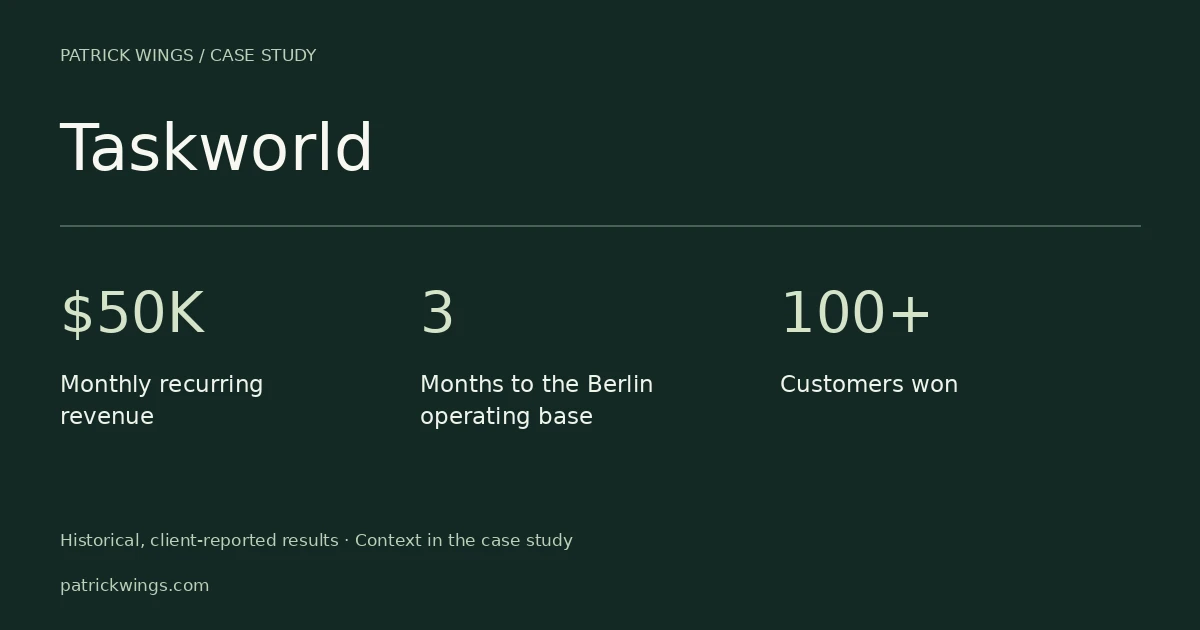
Monthly recurring revenue
Built from zero within 14 months.
Months to the Berlin operating base
Local entity, presence and team.
Customers won
The reference names Allianz, BASF and Roche.
Historical, client-reported results. Measurement limits are explained in the case.
The approach at a glance
- 01
approx. 3 months
Foundation & GTM
DACH strategy, company formation, specialist coordination, Berlin presence and local team.
- 02
approx. 1 month
Localisation & authority
German website and sales materials, PR, local profiles and search-led content.
- 03
3+ months
Campaigns & pipeline
Search, social, landing pages, nurture, daily lead handoff and reporting.
The starting point: global strength, limited local awareness
Taskworld is a cloud-based collaboration and project management platform. It was already growing in English-speaking markets. Germany offered additional opportunity, but local awareness, an established reference base and German-language content were missing.
Entering from abroad also required coordination of company formation, tax, privacy requirements and local operations. The core team needed to remain focused on existing Asian markets. Taskworld initially estimated six to twelve months before commercial activity could begin. That figure was a planning estimate, rather than a measured result.
The mandate: connect operations, credibility and demand
Taskworld chose a local operating partner rather than building every market-entry capability internally. The brief therefore extended well beyond translating a website or running individual ads.
Three objectives needed to work together: establish a credible German base, create demand through local messaging and authority, and develop enterprise and mid-market pipeline. Campaigns needed a prepared customer journey and a clear sales process behind them.
Phase 1: DACH strategy and Berlin operations
The first phase established market priorities, positioning and the launch path. In parallel, the team coordinated the German entity and operating requirements, with specialists supporting legal and tax matters.
A local base in Berlin was established within three months. A German presence and German-speaking team created local execution capacity. This enabled local engagement while the core team continued serving existing markets. The operating base was part of the commercial foundation.
Phase 2: localisation, PR and specialist authority
A native software and IT specialist localised the website and key sales materials. Benefits, applications and buying arguments needed to become clear and relevant to German-speaking prospects.
PR highlighted the Berlin headquarters, product updates and market-specific offers. German LinkedIn and XING profiles extended the presence. SEO landing pages, use cases, articles and blog posts created material for search, social media, nurture and sales. Content therefore supported several parts of the local customer journey.
Phase 3: from campaign response to sales handoff
Google Search, LinkedIn and XING reached enterprise and mid-market audiences. Localised landing pages and conversion-focused content connected the campaign message with a clear next step.
Email and newsletter programmes nurtured contacts. Leads were delivered to sales daily. Reporting every two weeks and ongoing optimisation maintained feedback between campaigns and sales. The reference describes a connected process of reach, capture, nurture and handoff.
Results: local presence and recurring revenue
The client reference reports US$50,000 monthly recurring revenue within 14 months, built from zero. It also reports more than 100 customer wins, including Allianz, BASF and Roche, and the Berlin operating base established within three months.
The figures describe the historical engagement as a whole. The source does not break down revenue contributions by channel or provide CAC or ROAS calculations. Results are therefore not attributed to individual ads or Patrick alone.
What Taskworld highlights about the engagement
The client feedback highlights the rapid establishment of the European headquarters in Berlin and support in growing to US$50,000 MRR. Local operating responsibility and marketing execution worked together.
For similar launches, that connection is the practical lesson: local credibility, the website, contacts and sales handoff should be ready before campaigns scale. The capabilities a business needs depend on its product, existing demand and available resources.
Documentation & measurement context
GROWSaaS Taskworld Case Study 2026, English client reference. Results overview: page 8; client feedback: page 9.
The figures document historical project results. Missing data is not replaced by assumptions. A new engagement receives its own objectives, definitions and measurement criteria.
Frequently asked questions
What did Taskworld achieve in DACH?
The reference reports US$50,000 MRR built from zero within 14 months, more than 100 customers and a Berlin base within three months.
Which channels were used?
Google Search, LinkedIn, XING, PR, SEO content, email and newsletter nurture were part of the reported system.
What was Patrick and GROWSaaS’s role?
The engagement connected local market entry, operating coordination, localisation and demand generation. It was a team effort with Taskworld and specialist partners.
Are these results guaranteed for a new launch?
No. Historical figures are not forecasts. Objectives, market conditions and resources require a separate assessment.
How can I tell whether a project is relevant to our marketing challenge?
Compare audience, market, starting point and the specific task with your situation first. Then review the described activities and metrics. A similar industry alone is not enough to expect the same results or timeline.
FROM IDEA TO EXECUTION