
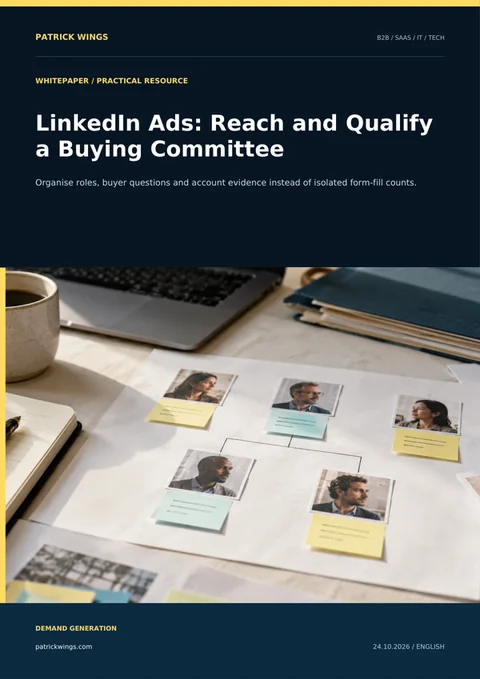
1. Map decisions and roles before targeting
A buying committee is the set of people who influence a particular decision, not a list of senior titles. One person may hold several responsibilities, and some participants appear only during security review or procurement. Advertising can reach professional audiences, but an impression cannot prove that a member belongs to an active buying group.
Use the original ROLE map: Responsibility, Objection, Learning need, Evidence. For the operational sponsor, record the workflow consequence; for the technical evaluator, system and security questions; for finance, the economic assumptions; for procurement, process requirements. Add users whose adoption will determine whether the product works in practice. Replace hypothetical entries with buyer-confirmed information as conversations progress.
Start with the decision and work backwards to roles. Do not assume every enterprise has the same committee structure or that a job title implies budget authority. A role map is a planning hypothesis with a confidence level, not a verified organisational chart.
The first useful output is a short table connecting a role to a question and a credible asset. The map becomes operational when marketing can explain which unanswered question each ad helps resolve and sales can confirm which people actually participate.
2. Translate account fit into a reachable audience
Define suitable accounts before choosing professional targeting attributes. Include the supported use case, company conditions, relevant geography and exclusions. Then ask which available audience criteria approximate that segment. LinkedIn's official lead-generation documentation describes professional attributes and Matched Audiences; check current options and eligibility in Campaign Manager rather than assuming every business property is directly targetable.
Treat targeting as an approximation. Profile information may be incomplete or stale, titles differ across companies and narrow combinations can exclude useful roles. Write down likely false positives and false negatives. An audience estimate is a planning aid, not the number of companies currently buying your category.
Where using an account list, establish ownership, approved provenance and a repeatable update process. A list match does not certify company fit or active intent. Reconcile apparent engagement back to CRM accounts where legitimately identifiable, and preserve an unknown category for unlinked activity.
Choose one coherent account hypothesis for the pilot. Avoid splitting every seniority level, function and company size into a separate tiny cell. Segmentation should answer a decision, such as whether technical evaluators need a different offer, rather than create a complex campaign structure that the team cannot interpret.
3. Build evidence-led messages for each role
Write one shared commercial argument and several role-specific entry points. The argument connects the business problem, supported product capability and credible limitation. The entry point changes according to the responsibility of the reader. Operations may need a workflow diagnostic; technical colleagues may need an integration checklist; finance may need a transparent cost model.
Keep claims consistent across roles. Do not promise operational simplicity to one audience while hiding substantial implementation work from another. A buying group will compare information, and inconsistent promises create friction during evaluation. Show assumptions and dependencies rather than polishing them away.
Use a message card: relevant situation, costly consequence, useful question, offered evidence and optional next step. The ad should earn attention through relevance and clarity. The asset must then fulfil the promised decision support. A click generated by curiosity alone is not a qualified commercial signal.
Test message meaning before visual polish. Ask a colleague who was not involved to explain whom the message is for, what it offers and what happens next. If the answer differs from your intent, fix the wording. Later performance comparisons should distinguish a change in audience from a change in message or asset.
4. Choose forms and destinations according to the promise
LinkedIn Lead Gen Forms offer selected fields, custom questions and lead syncing according to the official product documentation. They can reduce the effort of responding inside the platform. That convenience does not mean every response indicates purchase intent. A person accepting a useful guide may want only the guide.
Choose a native form when the promised exchange is clear and the team can reliably fulfil and process it. Choose a website destination when the buyer needs substantial explanation, interactive evaluation or a direct product experience. Neither route is universally superior. Compare downstream relevance and the actual task, not form completion alone.
Ask only questions needed to fulfil the promise or make a useful routing decision. For example, a supported workflow question may be more actionable than asking for a broad budget range before the problem is understood. Check that profile-derived data is still suitable for business follow-up rather than treating prefilled fields as verified truth.
Write the completion message and delivery path before launching. Confirm who receives the response, which permissions are recorded and whether sales follow-up is requested. Test lead syncing end to end, including a duplicate and an existing customer. A low-friction form attached to a broken handover creates cheap records and expensive confusion.
5. Use retargeting as decision support with boundaries
Official LinkedIn documentation describes audiences based on people opening or submitting Lead Gen Forms. Conversion tracking also provides defined mechanisms for connecting observed actions to advertising. These capabilities can support a sequence of relevant information, but they do not reveal the complete private deliberations of a buying committee.
Design a sequence around the next unresolved question. Someone who explored an operational guide might benefit from an implementation checklist. A person who requested a technical discussion should not continue receiving introductory prompts as though nothing changed. Align exclusions and handover status with the current relationship where the implementation permits it.
Do not treat repeated exposure as proof of engagement or assume that everyone at a targeted company saw the same sequence. Available audience size, privacy requirements and account settings can constrain execution. Verify requirements in the current official documentation and actual account before promising a narrowly segmented retargeting plan.
Set a review rule for repetitive delivery and complaints, and provide a useful alternative path. If an audience is too small to support the intended test, broaden the decision scope thoughtfully or choose another distribution mechanism. Do not dilute company fit merely to make a campaign technically deliver.
6. Measure account progress without inventing influence
Track person-level responses and account-level progress separately. Three people from one company are three contacts, one engaged account and potentially one opportunity. They are not automatically three qualified deals. Record known relationships and mark suspected links as unverified until evidence supports them.
Define meaningful account progress through buyer-confirmed facts: a shared problem, another relevant role joining a conversation, an agreed technical evaluation or a documented commercial next step. Aggregated engagement can help prioritise inspection, but it should not advance an opportunity stage automatically without the agreed evidence.
When reporting influence, specify the rule. “An identifiable contact associated with this opportunity responded to the campaign before its creation” is a reproducible association. It is not proof that the campaign caused the opportunity. Keep sourced and influenced views distinct and do not add them together as incremental pipeline.
Review accounts with sales on a regular schedule. Ask which role remains absent, what question blocks progress and whether advertising can supply useful evidence. Sometimes the next best action is a direct conversation, product clarification or procurement document rather than another ad. The programme succeeds by supporting an accountable buying process, not by making every interaction attributable to advertising.
Technical capabilities and sources
LinkedIn Lead Gen Forms can collect selected fields and custom questions and support lead syncing. LinkedIn Lead Gen Forms
LinkedIn documents retargeting options for members who open or submit a Lead Gen Form. LinkedIn Lead Gen Form audiences
LinkedIn conversion tracking requires a data source, defined conversions and association with ad sets. Get started with LinkedIn Conversion Tracking
The Insight Tag documentation describes website conversion-tracking setup. Set up Insight Tag conversion tracking
GA4 campaign URL parameters identify referring campaigns in acquisition reporting. Campaign URL parameters in GA4
Lifecycle stages can categorise contact and company progress; configure the organisation’s acceptance rules separately. Use HubSpot contact and company lifecycle stages
CRM lead scores can use actions and properties; a score remains an aid to prioritisation rather than proof of a purchase project. Understand HubSpot lead scoring
HubSpot workflow settings include controls for enrollment and suppression, subject to the workflow type. Manage HubSpot workflow settings
7. Define person and account evidence separately
Begin the reporting model with two ledgers. The person ledger records an identifiable response, relevant role, requested help and permission status. The account ledger records company fit, known participating roles, buyer-confirmed problem and any linked opportunity. Connect the ledgers where evidence permits. Do not infer identifiable committee membership from aggregated demographic reporting.
A content respondent becomes qualified only under the agreed fit and need rule. An engaged account is a company with documented relevant activity under a separately written rule. Neither is automatically an opportunity. Sales needs an accepted buying process, a commercial scope and a next step. Keep the number of people contributing to each account visible so several responses do not inflate the apparent deal count.
Distinguish missing role coverage from missing purchase intent. Reaching a technical role may be useful, but the project may still have no sponsor or priority. Conversely, an active sponsor can bring colleagues into a conversation without any measurable advertising response. The map must accept both cases. Review a few account histories with sales and ask whether each recorded step reflects buyer evidence or a marketing interpretation. Store the confidence and provenance of account relationships, especially when names, subsidiaries or company domains are ambiguous.
| Account object | Confirmed evidence | Do not infer |
|---|---|---|
| Person response | Actual request and role context | Budget authority from a title |
| Accepted account | Fit plus relevant decision question | Active project from impression |
| Opportunity | Accepted buying process | Several form fills as several deals |
8. Budget for account learning and sales capacity
The budget question is not merely how many form fills the team can afford. Ask how many suitable accounts can be reached, how much decision support can be produced and how many account conversations sales can responsibly handle. Allocate creative and specialist review time, especially for technical or financial assets that must remain accurate.
Define cost per accepted account as included programme cost divided by distinct accounts meeting the written acceptance rule. Keep media CPL alongside it. If €15,000 programme cost produces 100 contacts across 40 companies and ten accepted accounts, the fictional person CPL is €150 and accepted-account cost €1,500. Neither figure is CAC. Assume two eventual customers and the programme CAC becomes €7,500 before any omitted costs. These are illustrative assumptions, not reference targets.
Create a downside in which responses concentrate in already engaged accounts or unsuitable functions. The same contact volume could then produce much less new account evidence. Specify what portion of the budget is for learning rather than immediate pipeline creation. A programme can merit continuation while long-cycle outcomes mature, but only with an explicit question, cash limit and evidence date. Do not use committee complexity to excuse unlimited spending without useful account progress.
| Account cost lens | Fictional calculation | Meaning |
|---|---|---|
| Person CPL | €15,000 / 100 | €150 per response |
| Accepted-account cost | €15,000 / 10 | €1,500 per suitable account |
| Programme CAC | €15,000 / 2 | €7,500 before omitted costs |
9. Validate forms, tracking and company linkage
Test native-form and website routes separately if both are used. For each route record source identifiers, promised asset, completion time, contact creation, company association, owner and next action. Verify that form answers arrive in the intended CRM fields and that a failed sync creates a visible exception. Manual recovery should preserve provenance rather than invent a new source.
Company matching needs special care. Personal email addresses, subsidiaries and consultants can create false links. Use the approved account-resolution policy, keep unverified matches flagged and let a responsible person review material ambiguities. Do not merge separate companies solely because their names look similar. A wrong account join can make coverage and opportunity influence look stronger than they are.
Use marked test cases for a new contact, an existing contact, an existing customer and a person whose company is unknown. Check fulfilment and suppression for each. Where Insight Tag or other conversion sources are implemented, follow current official documentation, confirm association with the correct advertising objects and inspect the resulting events. Browser and CRM totals need not match perfectly; explain processing delay, matching limits and counting rules. The release owner should approve a reconciliation note before commercial reporting begins.
| Linkage case | Verification | Exception owner |
|---|---|---|
| Subsidiary respondent | Correct company relationship | Account operations |
| Existing customer | Customer route and exclusions | Customer owner |
| Unidentified company | Unknown flag retained | CRM reviewer |
10. Work through a fictional account programme
FICTIONAL ACCOUNT EXAMPLE — Assume Nordlicht Workflow spends €18,000 on media and €6,000 on content and operations over a bounded test. Assume 90 valid respondents across 45 identifiable companies, 18 companies meeting the accepted-account rule, nine sales-accepted opportunities and three eventual wins. Assume each win represents €18,000 recurring annual contract value. Every number is invented for this example.
Media CPL is €200. Programme cost per accepted account is €24,000 / 18 = about €1,333. Programme cost per opportunity is about €2,667. Programme CAC is €8,000 after all three wins are observed. Nine opportunities represent €162,000 unweighted first-year scope; three wins represent €54,000 contracted ARR. These are different commercial objects and neither equals recognised revenue by default.
Assume 30 of the respondents work at just five companies. A contact-level chart can therefore exaggerate breadth. Inspect whether those five companies added relevant roles, clarified a problem or simply generated repeat learning activity. Next assume only two accepted accounts have a known technical evaluator. The corrective hypothesis is to improve technical decision support, not automatically to buy more operational-manager responses. Test that hypothesis within the same account boundary and verify whether sales observes useful role participation rather than merely another cluster of cheap contacts.
| Account example | Fictional result | Interpretation |
|---|---|---|
| Accepted accounts | 18 of 45 companies | Written account rule |
| Opportunity cost | €24,000 / 9 | About €2,667 programme cost |
| Contracted ARR | 3 × €18,000 | €54,000 before finance recognition |
11. Diagnose reach, role relevance and buying progress
Use three diagnostic layers. Reach asks whether the intended professional audience can actually receive the programme. Relevance asks whether the message and asset answer a real role-specific question. Buying progress asks whether suitable accounts establish a credible commercial next step. A failure at one layer should not be disguised by success at another.
If delivery is limited, inspect current audience eligibility and actual account settings before changing the business segment. If response is strong but role relevance weak, inspect targeting approximations and the promise. If suitable roles consume content without account progress, ask sales whether the problem has priority, whether a sponsor exists and what question remains unanswered. Advertising may help with evidence, but cannot supply internal authority that the buyer does not have.
Review repetitive delivery, complaints and mismatched follow-up as quality signals. High frequency without useful progress can indicate a narrow audience or an exhausted offer. Avoid inventing a universal frequency threshold; decide from audience scope, complaints, asset fatigue and commercial evidence. Stop misleading claims or broken fulfilment immediately. Pause expansion when company linkage is unreliable. Redesign the account hypothesis when repeated buyer conversations show the use case is not a priority, rather than refreshing creative indefinitely to hide a commercial mismatch.
| Committee symptom | Question | Possible correction |
|---|---|---|
| Mostly one function | Does another role need different evidence? | Test role-specific help |
| Many people, few companies | Is activity concentrated? | Report account breadth |
| Good roles, no next step | Is the problem a priority? | Review with account owner |
12. Hand over an account brief without speculative profiling
Give sales an account brief that separates confirmed facts, hypotheses and unknowns. Confirmed facts include the person's submitted request, known company relationship, stated question and any agreed next action. Hypotheses might concern which role could sponsor a project. Unknowns include budget authority and internal approval sequence until the buyer confirms them.
The brief should help start a relevant conversation, not encourage a claim that “your whole company has been researching us”. Aggregated campaign engagement does not justify that statement. Refer to the actual request and offer useful clarification. Ask whether another colleague should be involved rather than assuming their identity or interest.
Assign the account owner responsibility for coordinating parallel outreach. Marketing should know when an active opportunity requires a different asset or exclusion policy. Customer success should receive customer-related responses that concern adoption or support. Operations owns unresolved company associations; the paid-media owner receives concise reasons when account relevance fails. Each handover needs an accept, clarify or reject outcome.
Reconcile the account brief with the next opportunity review. Did another relevant role join, was an evaluation agreed, or was the project deferred? Record the answer without forcing progress. An honest “not a priority this quarter” can support a respectful later review and prevent weeks of irrelevant retargeting.
| Briefing element | Status | Handling |
|---|---|---|
| Submitted question | Confirmed | Use to open conversation |
| Possible sponsor | Hypothesis | Ask, do not assert |
| Approval sequence | Unknown | Discover with buyer |
13. Run a staged committee-learning programme
Days 1–30 establish one account hypothesis and a small role map. Create one shared commercial argument, two useful role-specific assets and the minimum reliable measurement routes. Test fulfilment, company association and account-owner routing. Ask sales to approve the acceptance rule before reporting accepted accounts. Do not begin with a complex sequence that the available audience cannot support.
Days 31–60 inspect who actually responds and which companies are represented. Review message meaning, role relevance and account concentration. Choose one change: a better technical answer, clearer operational framing or a revised fit boundary. Track the change date and keep later responses distinguishable. Coordinate follow-up with account owners so advertising does not contradict live conversations.
Days 61–90 examine account progress and unresolved questions. Report known role participation, accepted accounts, opportunities and outcome maturity. Compare cost with the approved learning envelope. Decide whether to continue an evidence-building programme, change the offer, pause technical faults or stop a weak hypothesis. Each choice requires a specific future observation date. A long buying cycle may justify longer observation, while a repeated lack of relevant problems justifies stopping sooner. Scaling means a new budget and capacity commitment, not simply widening every audience until lead volume rises.
14. Copy the buying-committee workbook
Account hypothesis: ___; supported problem: ___; company conditions: ___; explicit exclusions: ___. For each role complete responsibility: ___; unresolved question: ___; proposed evidence: ___; current confidence: ___; buyer-confirmed facts: ___. Keep the planning role map separate from the verified opportunity map.
Audience plan: available criteria: ___; expected mismatches: ___; account-list owner if used: ___; update rule: ___; technical eligibility checked on: ___. Message plan: shared argument: ___; operational entry point: ___; technical entry point: ___; asset review owner: ___. Fulfilment route: native form / website / other ___; requested next step: ___; permission handling: ___.
The monthly decision sheet lists contacts, distinct identifiable accounts, accepted accounts, opportunities, unresolved outcomes, programme cost and cost scope. Add a short concentration note: how much activity belongs to the largest few accounts? Add a missing-role note based on confirmed conversations, not inferred personal surveillance.
Continue when relevant accounts are resolving useful questions within a bounded budget. Modify a role-specific evidence gap. Pause failed fulfilment or unreliable account joins. Stop when the account hypothesis repeatedly fails commercial relevance without an affordable repair. Name the account owner and media owner for each action. Before release, ask whether the programme would still be useful if no platform could claim credit for the final sale. That question keeps decision support connected to the buyer rather than the attribution report.
Distinguish evidence coverage from advertising coverage
A role coverage report should answer which decision responsibilities are understood, not merely how many titles were exposed. For each accepted account, record the buyer-confirmed questions, the responsible role where known, the asset that could help and the person who can verify progress. Leave responsibility blank when it is unknown. Do not fill the map by scraping unrelated profiles or assuming the most senior available person owns the decision.
Advertising coverage is a separate distribution question. A programme may reach relevant functions without identifying everyone who saw an impression. A conversation may reveal an important procurement participant who never interacted with the campaign. Both observations belong in the account review without forcing them into the same attribution model. The evidence map serves the buying process; the delivery report serves media operation.
Before commissioning another asset, ask whether the gap is informational, relational or structural. An informational gap may need an explanation. A relational gap may require the sponsor to invite a colleague. A structural gap may mean the company lacks budget or the product lacks a required capability. Only the first is directly solved by publishing another document. Record the distinction so content production does not become a default response to every stalled account.
Maintain the account boundary as the business changes
Lists and fit rules age. Companies merge, priorities change and the product gains or loses support for a use case. Assign a regular review of account eligibility and maintain a reason for additions and removals. Preserve historical membership so later analysts can reconstruct what the programme actually targeted.
When sales changes an account's status, specify what happens to open tasks, active messages and future list updates. A customer conversion may require coordination with customer success rather than simply exclusion from every useful resource. A lost opportunity may remain a suitable company with different timing, or may reveal a structural mismatch. Use the recorded reason rather than a universal recycled audience. The closing package should let the next owner explain why a company remains included, which roles are genuinely known and what evidence would justify the next commercial step.
Primary sources and review date
- LinkedIn Lead Gen Forms — 2026-10-24
- LinkedIn Lead Gen Form audiences — 2026-10-24
- Get started with LinkedIn Conversion Tracking — 2026-10-24
- Set up Insight Tag conversion tracking — 2026-10-24
- Campaign URL parameters in GA4 — 2026-10-24
- Use HubSpot contact and company lifecycle stages — 2026-10-24
- Understand HubSpot lead scoring — 2026-10-24
- Manage HubSpot workflow settings — 2026-10-24

INTERACTIVE / FROM READING TO ACTION
Three checkpoints for your implementation
Choose a checkpoint and track your reading progress. Checks are neither saved nor sent and do not score your business.
CHECKPOINT 01
1. Map decisions and roles before targeting
A buying committee is the set of people who influence a particular decision, not a list of senior titles.
CHECKPOINT 02
2. Translate account fit into a reachable audience
Define suitable accounts before choosing professional targeting attributes.
CHECKPOINT 03
3. Build evidence-led messages for each role
Write one shared commercial argument and several role-specific entry points.
Frequently asked questions
Who is this resource for?
B2B SaaS marketing and sales teams selling to identifiable companies through decisions involving multiple stakeholders. Use the resource with the people accountable for implementation and approval.
What practical outputs can we create?
A role and objection map for the buying committee A testable audience and account hypothesis A graduated offer and form architecture A measurement and handover model for people and accounts
What is included in the PDF?
14 chapters with explanations, decision rules, examples and working materials. 16 designed PDF pages including sources and a transfer canvas.
Are the examples real client results?
No. Cases labelled fictional are used to explain the method. Example figures are assumptions, not industry benchmarks or promised outcomes. Apply the approach to your own evidence.
Are the online edition and download free?
Yes. The complete resource is currently available to read and download without payment or a registration form.
Is there a German edition?
Yes. Use the language switch for the complete German online edition and German PDF.
Sources & context
Primary sources checked 24 October 2026. The working models are editorial decision aids. Fictional examples do not replace your own customer evidence. Verify current platform capabilities before implementation.