
THE SHORT ANSWER
Monitor a relaunch by comparing actual delivery and reader journeys with the approved migration inventory. Check technical correctness first, then investigate discovery, indexing and search outcomes over time. A single traffic total cannot distinguish a broken redirect from seasonality, and short-term ranking movement alone does not establish that the migration failed.
For the broader picture of technical foundations, useful content and visibility measurement, read the pillar guide SEO, GEO and AEO for SaaS: visibility that supports buying decisions.
Define monitoring before the release
Select critical URLs, content families, languages and business journeys from the approved inventory. Record pre-launch response behaviour, available search observations and meaningful conversion paths. Define who handles technical incidents, content mismatches and analytics defects. Establish investigation criteria based on business consequence rather than a universal percentage decline. Document concurrent changes, campaign activity and known seasonality. A baseline should describe its coverage and limitations, not present a single number as the expected future. Ensure the people responsible can access the relevant systems during the launch window. Explore this further in the guide Analysing server logs to answer SEO questions.
Check the public delivery contract first
Immediately after deployment, request priority old and new addresses through production infrastructure. Verify status codes, redirect destinations, canonical and robots directives, language references and main content. Check unknown routes and files as well as the homepage. Confirm that a staging noindex rule or authentication barrier has not reached production. Test navigation and conversion paths directly. Compare the result with the approved treatment for that URL. Technical success means the intended page and controls are actually delivered; a successful build process alone cannot establish that public requests behave correctly.
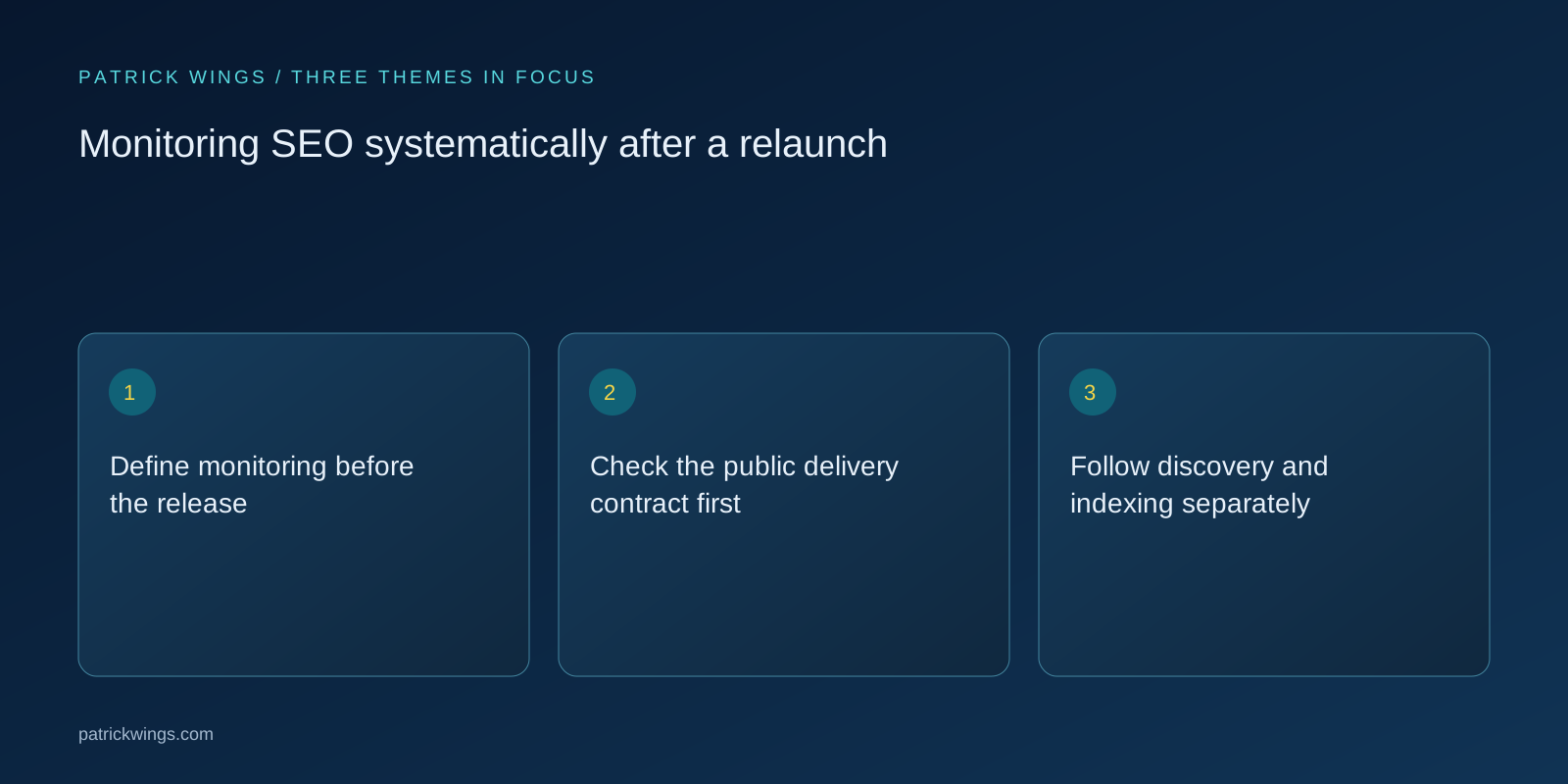
Follow discovery and indexing separately
Check sitemap delivery and processing alongside available crawl and index reports. Inspect important exceptions rather than treating every excluded address as equally urgent. Compare observation dates with launch time because stored reports may describe the previous implementation. Use verified server evidence to understand access when appropriate, while remembering that a request does not prove indexing. Distinguish an intended retired page from a valuable new page that remains inaccessible. Search engines need time to recrawl and reassess moves, so communicate uncertainty without using processing delays as an excuse to ignore demonstrable defects. Explore this further in the guide Building SEO and AI reports around decisions.
Segment outcomes by the changed system
Review search landings and business journeys by template, language, topic and migration action. Match old and new destinations where possible instead of comparing addresses that no longer represent the same content. Check analytics continuity and event definitions before interpreting conversion changes. A tracking omission can resemble a demand collapse. Investigate whether affected pages share a deployment component or content decision. Keep a dated incident log linking observations, hypotheses, fixes and retests. This makes it easier to tell a persistent technical fault from a broad market change or a known measurement discontinuity.

Illustrative example: a language-specific regression
Imagine an illustrative relaunch where aggregate visits appear broadly stable but German implementation guides lose their internal navigation. A segmented check reveals a translated menu mapping error; direct URL requests still work. The team repairs the menu, tests representative guides and records the correction separately from ordinary search processing. Meanwhile, an intentional retired campaign page remains absent as planned. This scenario shows why cohorts and inventory matter. It is not a claim about expected recovery speed or evidence that every language-specific decline comes from navigation.
Close incidents through evidence and ownership
Assign each material exception an owner, next action and retest criterion. Escalate failures that block critical content or business tasks instead of waiting for the next reporting cycle. Keep monitoring frequency appropriate to unresolved risk, then move stable areas into routine review. Preserve the inventory and change record for later questions. Success means verified delivery, functioning journeys and explained exceptions, not an immediate return to every historic ranking. Avoid promising a fixed recovery date. Report what is observed, what remains uncertain and which concrete test will resolve the next decision.
INTERACTIVE / FROM READING TO ACTION
Three checkpoints for your implementation
Choose a checkpoint and track your reading progress. Checks are neither saved nor sent and do not score your business.
CHECKPOINT 01
Follow discovery and indexing separately
Check sitemap delivery and processing alongside available crawl and index reports.
Explore in the article ↗CHECKPOINT 02
Segment outcomes by the changed system
Review search landings and business journeys by template, language, topic and migration action.
Explore in the article ↗CHECKPOINT 03
Illustrative example: a language-specific regression
Imagine an illustrative relaunch where aggregate visits appear broadly stable but German implementation guides lose their internal navigation.
Explore in the article ↗Frequently asked questions
How quickly should rankings recover?
There is no dependable universal timetable. Investigate concrete defects and communicate search processing uncertainty.
Why segment languages?
Aggregate totals can hide problems confined to one locale, template or navigation component.
Does a successful build prove a successful migration?
No. Test public responses, content, navigation and business paths after deployment.
How can I put “Define monitoring before the release” into practice?
Select critical URLs, content families, languages and business journeys from the approved inventory. Record pre-launch response behaviour, available search observations and meaningful conversion paths. Define who handles technical incidents, content mismatches and analytics defects.
What matters when working on “Check the public delivery contract first”?
Immediately after deployment, request priority old and new addresses through production infrastructure. Verify status codes, redirect destinations, canonical and robots directives, language references and main content. Check unknown routes and files as well as the homepage.